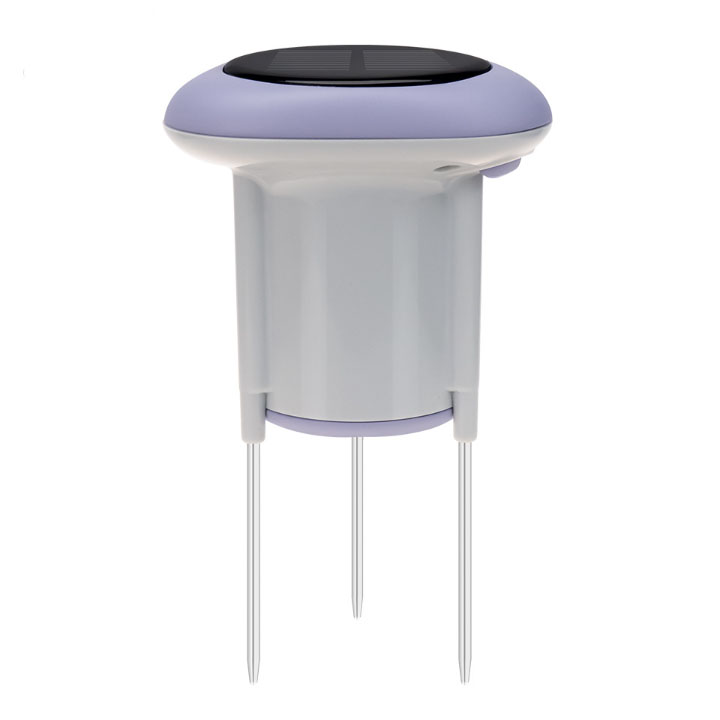
Why Does Your Soil Testing Always Fall Short? How This All-in-One Sensor Solves the Five Major Challenges of Temperature/Moisture/pH/Conductivity/Acidity-Alkalinity/NPK in One Go
I. Common Pain Points in Traditional Soil Testing
To obtain comprehensive soil data, one often needs separate moisture meters, pH meters, conductivity pens, and nutrient rapid testers. Frequent switching between devices, inconsistent operating procedures, and increased learning costs all contribute to higher error rates.
Data obtained from different devices at different times and locations is difficult to correlate and analyze. The intrinsic relationships between temperature, moisture, pH, and nutrient content cannot be accurately represented due to time differences in measurements.
Many ordinary sensors, after prolonged burial in soil, are prone to data drift, probe corrosion, and other issues, making them unsuitable for continuous monitoring needs.

II. Working Principle of the All-in-One Soil Detector
-
Temperature and Moisture Measurement: Uses high-frequency capacitance or Frequency Domain Reflectometry (FDR) technology to measure soil dielectric constant and convert it to volumetric water content, while a built-in high-precision thermistor monitors soil temperature in real time.
-
pH Measurement: Uses ion-selective electrodes or solid-state pH sensors to determine acidity-alkalinity by measuring hydrogen ion activity in the soil solution.
-
EC Conductivity Measurement: Uses four-electrode or two-electrode AC excitation methods to measure the conductivity of the soil solution, reflecting the total soluble salt content in the soil.
-
NPK Measurement: Uses ion-selective electrodes or spectral reflectance technology to detect the effective content of nitrogen, phosphorus, and potassium in the soil respectively.
III. What Problems Can This All-in-One Sensor Solve for You
A single instrument simultaneously measures five core indicators—temperature, moisture, pH, conductivity, and NPK—completely eliminating the cumbersome process of switching between multiple devices.
All five data points are obtained at the same time and same location, ensuring the intrinsic correlation between parameters and providing a reliable data foundation for precise fertilization and irrigation decisions.
Using imported high-precision sensing elements, pH accuracy reaches ±0.1, EC repeatability error is below 2%, temperature accuracy is ±0.5°C, and moisture error is ±3%.
316L stainless steel, titanium alloy, or Hastelloy probes are available for different soil environments, offering corrosion resistance and oxidation resistance suitable for long-term burial monitoring.
Supports RS485 (Modbus RTU), 4-20mA, 0-5V, 0-10V, and other output methods, easily connecting to PLC, DTU, RTU, and various data acquisition terminals.
The fully sealed design achieves IP68 protection rating, allowing direct burial in soil for long-term operation, adapting to a wide temperature range of -30°C to +70°C, ensuring data continuity throughout the year.
IV. Key Application Scenarios
Scenario 1: Smart Field Agriculture and Precision Farming
Precision agriculture soil moisture temperature sensor plays a core role in large-scale farmland. It helps growers master real-time moisture and temperature distribution across different soil depths, enabling differentiated irrigation planning to achieve water conservation and yield increase. When integrated with smart irrigation systems, precision agriculture soil moisture temperature sensor can automatically start and stop irrigation equipment based on actual soil moisture deficits, preventing over-irrigation or under-irrigation. Additionally, the continuous monitoring data from precision agriculture soil moisture temperature sensor can be used to establish crop growth models and optimize water and fertilizer management strategies throughout the entire growth cycle.
Scenario 2: Greenhouses and Protected Agriculture
In greenhouses, although the environment is controllable, soil conditions remain complex. This sensor can be deployed in cultivation beds, nutrient solution tanks, or substrate bags to provide real-time feedback on the water and nutrient status around the root zone. Its NPK detection function can precisely guide nutrient solution ratio adjustments, ensuring crops grow in an optimal nutrient environment.
Scenario 3: Hydroponics and Soilless Cultivation Nutrient Solution Monitoring
For hydroponic and substrate cultivation systems, the stability and balance of the nutrient solution are critical. This device can serve as a soil probe for hydroponic nutrient solution monitoring, periodically measuring changes in EC, pH, and key nutrient content in the circulating nutrient solution. The soil probe for hydroponic nutrient solution monitoring helps growers promptly detect salt accumulation or nutrient imbalances in the nutrient solution, allowing intervention before crops show deficiency symptoms. In practice, the rapid response characteristics of the soil probe for hydroponic nutrient solution monitoring make it an indispensable feedback component in automated nutrient solution recirculation management systems.
Scenario 4: Ecological Restoration and Soil Improvement
In scenarios such as saline-alkali land improvement and contaminated site assessment, this sensor can continuously monitor trends in soil pH, EC, and nutrient changes, providing quantitative evidence for dynamic adjustment of improvement measures.
Scenario 5: Research and Teaching, Field Trials
Agricultural researchers and university faculty and students can use this device to rapidly obtain large amounts of soil profile data, significantly improving experimental efficiency and standardization of data collection.
V. Summary of Core Product Advantages
Specific Performance: One device simultaneously measures five indicators—temperature, moisture, pH, EC, and NPK
Specific Performance: Industrial-grade sensing chip, pH accuracy ±0.1, EC error ≤2%
Specific Performance: RS485, 4-20mA, 0-5V, 0-10V optional
Specific Performance: 316L stainless steel/titanium alloy probes, IP68 protection rating
Specific Performance: Factory calibrated, insert directly into soil for immediate readings
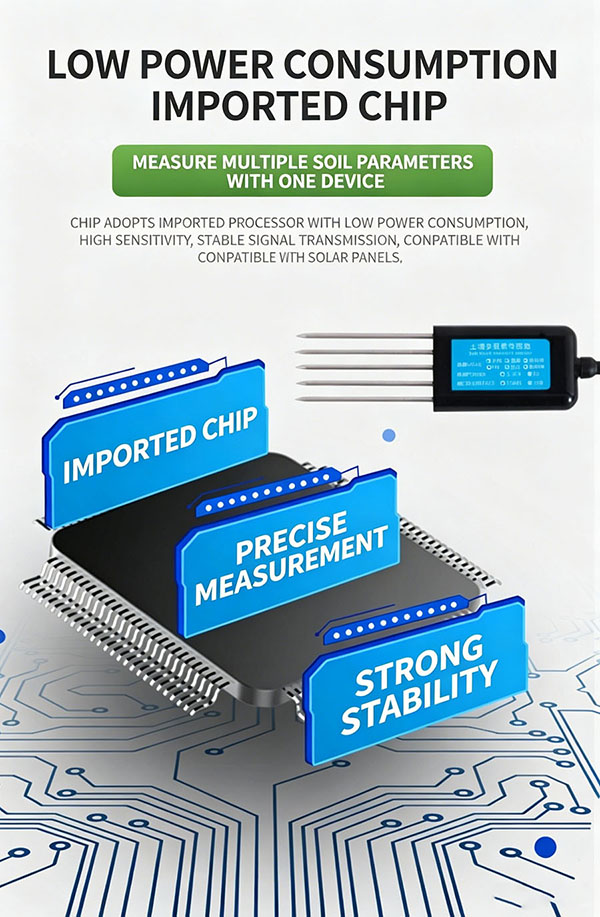
Specific Performance: Operating current below 15mA, compatible with solar power systems
VI. How to Select the Right Model
Recommendation: Choose 316L stainless steel probes for regular soil, titanium alloy probes for high-salinity/corrosive soil
Recommendation: Choose P Series for portable handheld use, F Series or W Series for fixed long-term burial
Recommendation: Choose DC12V/24V for locations with grid power, choose solar-compatible version for remote areas without electricity
Recommendation: Choose RS485 wired for short-range centralized collection, choose 4G/LoRa wireless for remote distributed monitoring
Recommendation: Choose standard length for surface detection, custom extended probes for deep detection
Recommendation: If existing system supports standard Modbus protocol, choose standard type; for specific output protocols, consult customization options
VII. Frequently Asked Questions
A: Yes. For high-salinity environments, we offer titanium alloy or Hastelloy probe options with strong corrosion resistance for long-term stable operation.
A: Supports RS485 Modbus protocol for direct connection to PLC or data loggers, and 4G/LoRa wireless transmission to cloud platforms, with mobile APP and computer-based historical data viewing.
A: It is recommended to remove the probe for cleaning and calibration every 3-6 months. The probe is made of corrosion-resistant materials, with a service life of 5-8 years in general soil conditions.
A: Different probe lengths can be customized, or the sensor can be installed in a tube-type monitoring station to achieve layered monitoring at 0-100cm depth profiles.
A: Yes. The device can be directly immersed in nutrient solution to measure EC, pH, and temperature. For NPK concentration measurement, calibration is required based on the ion strength of the nutrient solution. Please consult technical support for specific calibration methods.
A: NPK measurement uses the ion-selective electrode method, and results are affected by soil moisture content and ion activity. It is recommended to measure under relatively stable soil moisture conditions and calibrate regularly with standard solutions. The NPK measurement values from this device can be used as a fertilization trend reference rather than an absolute quantitative value.
VIII. Conclusion
IX. How to Get Product Support
📧 Send Requirements: wangweisu@klsensor.com
🖱️ Click Online Customer Service to Chat with Technical Engineers in Real Time
A Guide to Selecting Hessman High-Definition Digital Display Integrated Temperature Sensors for Corrosive Media in Chemical Plants