Digital Display Intelligent Temperature Controller Selection – Why Does Your Heating System Always Fail to Control Temperature Accurately?
In many fields such as industrial heating, laboratory temperature control, food processing, and HVAC, the accuracy of temperature control directly affects product quality, equipment safety, and energy costs. However, many engineers encounter a common problem in practical applications: Even with a temperature controller installed, why does the temperature still fluctuate and fail to control accurately?
The key to the problem often lies not in the quality of the controller itself, but in whether the selection matches the actual working conditions. This article will systematically explain the key points for selecting digital display intelligent temperature controllers, helping you solve the problem of "inaccurate temperature control" at the source.
I. Why Is Your Temperature Control System Susceptible to Interference? – Choose an Adjustable anti-interference temperature controller
Problem: On-site electromagnetic interference causes temperature display fluctuation and output disorder
In industrial sites, equipment such as variable frequency drives, high-power motors, and contactors generate strong electromagnetic interference. In such environments, ordinary temperature controllers are prone to abnormal conditions such as unexplained temperature display fluctuations, unstable output signals, and even false alarms, seriously affecting production stability and product yield.
Solution
Choosing an Adjustable anti-interference temperature controller can effectively suppress the impact of electromagnetic interference on temperature measurement signals. This type of controller typically features built-in digital filtering circuits, allowing users to adjust the filtering coefficient according to on-site interference intensity, balancing response speed and anti-interference capability.
Selection Key Points
-
Digital filtering function: Confirm whether the controller has adjustable digital filtering parameters
-
Input isolation design: Whether the input is electrically isolated from the power supply and output
-
Anti-interference level: Whether it meets industrial electromagnetic compatibility standards (e.g., IEC 61000)
-
On-site testing: Conduct simulation tests near interference sources to verify stability
II. Why Do Ordinary Temperature Controllers Lack Precision? – Choose a High-resolution PID intelligent temperature control instrument
Problem: Large temperature fluctuations unable to meet precision process requirements
Ordinary temperature controllers typically have a display resolution of only 1°C or 0.5°C, and their PID control algorithms are also relatively basic. For applications requiring ±0.1°C or even higher temperature control accuracy (such as laboratory constant temperature baths, precision drying ovens, reactor temperature control), ordinary controllers simply cannot meet the requirements, with temperature fluctuation ranges often exceeding ±1°C of the set value.
Solution
Selecting a High-resolution PID intelligent temperature control instrument with a display resolution of up to 0.1°C or even 0.01°C, combined with high-performance PID control algorithms, enables smoother and more precise temperature regulation, keeping temperature fluctuations within a very small range.
Selection Key Points
-
Display resolution: Confirm required accuracy (0.1°C, 0.01°C, etc.)
-
PID algorithm performance: Whether it has auto-tuning capability and can adapt to different load characteristics
-
Sampling cycle: Faster sampling speed results in more timely response
-
Control output type: Relay, SSR, 4-20mA, etc., must match the actuator
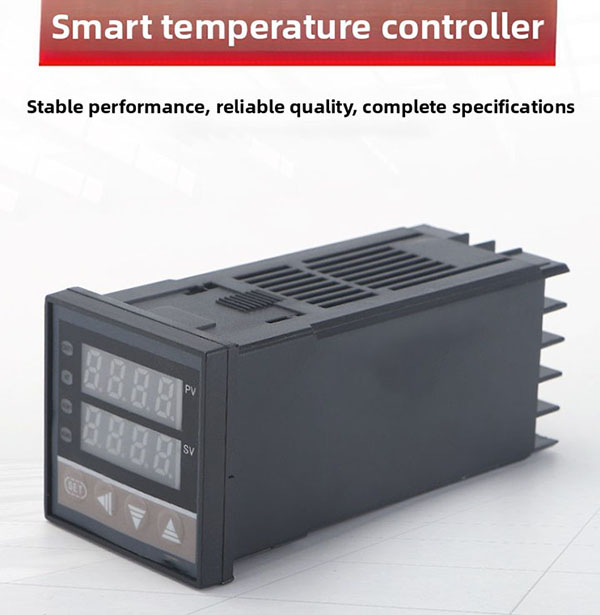
III. Can Thermocouples, PT100, and 4-20mA All Be Connected? – Choose a Multi-input universal intelligent temperature control instrument
Problem: Different sensor types cannot share the same temperature controller
In practical applications, temperature measurement elements come in many varieties: K-type thermocouples, S-type thermocouples, PT100 RTDs, 4-20mA transmitter signals, 0-10V voltage signals, etc. If a temperature controller only supports a single input type, customers need to purchase different controller models for different sensors, increasing inventory pressure and selection complexity.
Solution
Choosing a Multi-input universal intelligent temperature control instrument allows users to freely switch input types through the menu. One instrument can adapt to various signals such as thermocouples, RTDs, and analog signals, greatly simplifying selection and management work.
Selection Key Points
-
Supported input types: Confirm whether it covers K/S/J/T/E type thermocouples, PT100/CU50 RTDs, 4-20mA/0-10V analog signals
-
Input switching method: Whether it can be set through software menu without hardware jumpers
-
Adjustable range: Whether the upper and lower limits of analog input range are customizable
-
Cold junction compensation: Whether thermocouple input has automatic cold junction compensation
IV. Complete Selection Checklist for Digital Display Intelligent Temperature Controllers
For quick selection, the following core selection parameters and considerations are listed:
Step 1: Confirm input signal type
-
Options: Thermocouple (K/S/J/T/E), RTD (PT100/CU50), Analog (4-20mA/0-10V)
-
Selection advice: Recommend choosing multi-input universal type for future sensor changes
Step 2: Confirm required control accuracy
-
Options: 1°C, 0.5°C, 0.1°C, 0.01°C
-
Selection advice: For precision processes, choose 0.1°C or higher; recommend High-resolution PID intelligent temperature control instrument
Step 3: Confirm control output method
-
Options: Relay contact, SSR drive voltage, 4-20mA linear current, SCR zero-crossing trigger
-
Selection advice: Relay suitable for on/off control; SSR and 4-20mA suitable for PID continuous regulation
Step 4: Confirm on-site interference conditions
-
Options: Ordinary environment, Strong electromagnetic interference environment
-
Selection advice: For interference environments, choose Adjustable anti-interference temperature controller
Step 5: Confirm installation dimensions
-
Options: 48×48mm, 72×72mm, 96×96mm, 48×96mm, DIN rail mount
-
Selection advice: Choose according to control cabinet panel cutout dimensions
Step 6: Confirm communication requirements
-
Options: No communication, RS485 (Modbus RTU), Ethernet, Wireless
-
Selection advice: For integration with DCS or host computer, choose with RS485 communication
Step 7: Confirm power supply voltage
-
Options: AC220V, AC110V, DC24V
-
Selection advice: Choose according to on-site power supply conditions
Step 8: Confirm alarm function requirements
-
Options: No alarm, High limit alarm, Low limit alarm, Deviation alarm
-
Selection advice: For over-temperature protection, configure at least one alarm output
V. Quick Selection Guide for the Three Keyword Corresponding Products
Your need: Strong on-site electromagnetic interference, temperature display fluctuates
-
Recommended product type: Adjustable anti-interference temperature controller
-
Key focus points: Digital filtering, input isolation, anti-interference level
-
Applicable scenarios: VFD-intensive workshops, welding machine rooms, near large motors
Your need: High-precision temperature control, temperature fluctuation within 0.1°C
-
Recommended product type: High-resolution PID intelligent temperature control instrument
-
Key focus points: Display resolution (0.1°C/0.01°C), PID auto-tuning, sampling cycle
-
Applicable scenarios: Laboratory constant temperature baths, precision drying ovens, reactors, medical sterilizers
Your need: Multiple sensor types on-site, need unified instrument management
-
Recommended product type: Multi-input universal intelligent temperature control instrument
-
Key focus points: Number of supported input types, software switching, customizable range
-
Applicable scenarios: Multiple equipment types, non-uniform sensors, retrofit projects
Your need: Multiple problems exist simultaneously
-
Recommended product type: High-end intelligent temperature control instrument with all three features
-
Key focus points: Anti-interference + High precision + Multi-input
-
Applicable scenarios: Complex industrial environments, high-standard process requirements
VI. Frequently Asked Questions
Q1: What does PID auto-tuning mean? How is it used?
A: PID auto-tuning means the temperature controller automatically measures the response characteristics of the heating system and calculates the most suitable PID parameters. Usage: After the system stabilizes, start the auto-tuning function, let the controller complete one heating and cooling cycle automatically, and the system will automatically save the optimal parameters.
Q2: What is the difference between relay output and SSR output?
A: Relay output is a contact switch suitable for on/off control, with limited lifespan; SSR output is a DC voltage signal (typically 12V/24V) driving a solid state relay, suitable for PID continuous regulation, with fast response, no contacts, and long lifespan.
Q3: How do you switch input types on a Multi-input universal intelligent temperature control instrument?
A: Typically set in the "input type" parameter in the instrument menu. Users select the corresponding code based on the actually connected sensor (e.g., K-type thermocouple select 0, PT100 select 1, 4-20mA select 2, etc.), without needing to open the instrument for hardware jumpers.
Q4: How do you set the filtering parameters on an Adjustable anti-interference temperature controller?
A: Generally set within a 0-10 second range. Higher values provide stronger anti-interference but slower response. It is recommended to start with a small value (e.g., 0.5 seconds), observe display stability, and gradually increase if fluctuation persists until the display stabilizes.
Q5: What power heating equipment can a High-resolution PID intelligent temperature control instrument control?
A: The temperature controller itself does not directly drive the load. By cooperating with actuators such as contactors, SSRs, and SCRs, it can control any power equipment from a few hundred watts to several hundred kilowatts. The instrument outputs a drive signal; specific power is determined by the actuator.
Q6: What should I do if there is a large deviation between the temperature displayed by the controller and the actual temperature?
A: First, check whether the sensor is installed correctly and wiring is correct. If confirmed to be correct, use the "measured value offset" parameter inside the instrument for correction, or perform a two-point calibration.
Q7: How do you network RS485 communication temperature controllers?
A: Connect the RS485 interfaces of multiple temperature controllers in parallel to a host computer (PLC/touch screen/industrial PC), using the Modbus RTU protocol for communication. Each controller must be set to a different communication address.
Q8: Should I select the controller or the sensor first during selection?
A: It is recommended to determine the sensor type and installation method first, then select a matching temperature controller input signal based on the sensor output type. If you choose a Multi-input universal intelligent temperature control instrument, there is no need to worry about matching issues.
VII. Conclusion
When selecting a digital display intelligent temperature controller, you should not only look at price and brand, but also pay attention to:
-
On-site interference conditions – Determines whether an Adjustable anti-interference temperature controller is needed
-
Temperature control accuracy requirements – Determines whether a High-resolution PID intelligent temperature control instrument is needed
-
Sensor type diversity – Determines whether a Multi-input universal intelligent temperature control instrument is needed
A correct selection solution not only makes your heating system control temperature more accurately and run more stably, but also reduces downtime, extends equipment life, and lowers energy costs.
If you have specific working condition parameters or special requirements, please contact the Kunlun Zhongda technical team. We will provide you with one-on-one selection guidance and system integration solutions.
How to Choose a Solar Soil Temperature and Humidity Sensor for Agricultural Greenhouses? – A Practical Guide to Avoiding Selection Traps
Dust Concentration Detector and Alarm – How to Build a Safety Defense Line for Your Factory?
Related blog