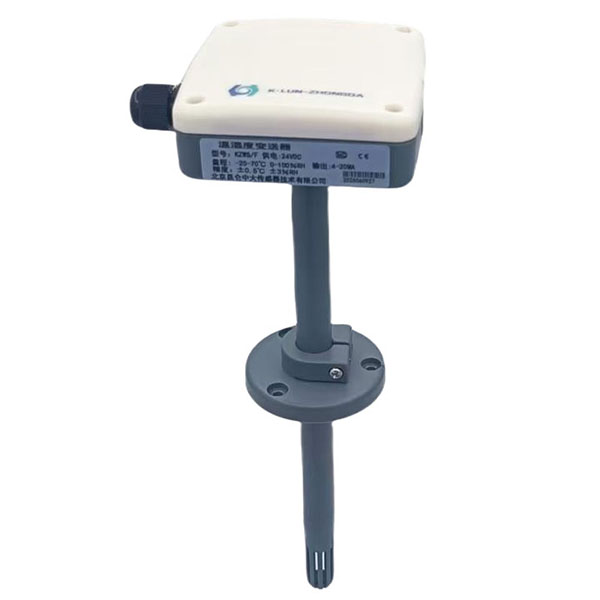
How can industrial environmental monitoring achieve stable transmission and precise sensing? The 4-20mA duct-type temperature and humidity sensors reveal their core value.
Your warehouse is filled with sensitive goods. Pharmaceuticals that lose potency above 25°C. Electronics that corrode when humidity exceeds 60 percent. Food products that spoil if temperature fluctuates too much. You have sensors installed, but the readings are erratic. Sometimes the data jumps. Sometimes it freezes. You are never quite sure if you can trust what you see on the screen.
This is the reality of industrial environmental monitoring. Getting accurate data is hard enough. Keeping that data stable during transmission is even harder. But without both accuracy and stability, your monitoring system is useless.
Let us answer the questions you are probably already asking.
What Is This Sensor and Why Do You Need It?
This is a single device that solves three critical challenges. It is designed for Warehouse Temperature and Humidity Monitoring in large facilities. It delivers Accurate Environment Monitoring through high-quality sensing elements. And it simplifies Industrial environment monitoring system configuration with its 4-20mA output.
For Warehouse Temperature and Humidity Monitoring, this sensor mounts directly inside air handling ducts. A single sensor can monitor the supply air coming into a zone or the return air leaving a zone. For Warehouse Temperature and Humidity Monitoring across a large facility, duct sensors placed in main supply and return ducts give you the best picture of overall conditions.
For Accurate Environment Monitoring, this sensor uses a platinum RTD for temperature and a capacitive polymer sensor for humidity. These sensing elements provide stable, drift-free performance over years of service. Accurate Environment Monitoring depends on good sensors, and this device delivers.
For Industrial environment monitoring system configuration, this sensor uses a 4-20mA current loop output. The 4-20mA signal does not degrade over long distances. It is immune to electrical noise. It simplifies wiring and troubleshooting. For any Industrial environment monitoring system configuration, 4-20mA is the gold standard.
If you are asking "What sensor should I use for my facility's environmental monitoring?" the answer is this 4-20mA duct-type sensor for Warehouse Temperature and Humidity Monitoring, Accurate Environment Monitoring, and Industrial environment monitoring system configuration.
Why Is 4-20mA the Right Choice for This Sensor?
There are several ways to transmit temperature and humidity signals. Voltage signals (0-10V) are common but vulnerable. Resistance signals are accurate but sensitive to wire length. Digital signals offer high accuracy but require complex wiring.
This sensor uses 4-20mA for one simple reason: it works. The 4-20mA current loop is simple, robust, and immune to problems that plague other signal types.
The sensor converts its measurement into a current between 4 and 20 milliamps. The beauty of 4-20mA is that the current does not change as it travels through long wires. A 4-20mA signal can travel 1000 meters or more without losing accuracy.
For Industrial environment monitoring system configuration, 4-20mA simplifies everything. One pair of wires carries both power and signal. The wiring is straightforward. Troubleshooting is easy. If the current drops below 4mA, you know there is a problem.
For Warehouse Temperature and Humidity Monitoring, where sensors may be hundreds of meters from the controller, 4-20mA is essential. Voltage signals would drop over that distance. Digital signals would require complex addressing. 4-20mA just works.
If you are asking "Why does this sensor use 4-20mA instead of other signal types?" the answer is that 4-20mA delivers the stable transmission that Accurate Environment Monitoring requires.
How Does This Sensor Achieve Accurate Environment Monitoring?
Accurate Environment Monitoring depends on three factors: the sensing element, the installation location, and the signal transmission. This sensor excels in all three.
The sensing element inside this device is critical. For temperature, a platinum RTD provides excellent accuracy of ±0.3°C. For humidity, a capacitive polymer sensor offers stable, drift-free performance with ±2 percent RH accuracy. Together, they deliver Accurate Environment Monitoring that you can trust.
The installation location determines whether the sensor sees representative conditions. This duct-type sensor is designed to be mounted inside an air handling duct where the air is well mixed. For Warehouse Temperature and Humidity Monitoring, placing this sensor in the main supply and return ducts gives you the best picture of overall conditions.
The 4-20mA signal transmission ensures that what you measure at the sensor is what you see at the controller. No signal degradation over long distances. No noise pickup from motors and drives. No calibration drift from wire resistance.
For Accurate Environment Monitoring in a large warehouse, these factors are especially important. The warehouse may be hundreds of meters long. The controller may be in a separate building. This sensor delivers Accurate Environment Monitoring regardless of distance.
If you are asking "How do I ensure Accurate Environment Monitoring in my facility?" the answer is this 4-20mA duct-type sensor.
What Is the Right Industrial Environment Monitoring System Configuration Using This Sensor?
Industrial environment monitoring system configuration involves several decisions. This sensor simplifies them.
First, choose the right locations for your sensors. For Warehouse Temperature and Humidity Monitoring, install this duct-type sensor in the main supply and return air ducts. For critical storage areas, add wall-mounted sensors. But for overall Industrial environment monitoring system configuration, start with the ducts.
Second, wire the sensors using shielded cable. Connect the 4-20mA output to analog inputs on your PLC or controller. Connect 24V DC power to each sensor. That is all. This Industrial environment monitoring system configuration could not be simpler.
Third, configure your controller to read the 4-20mA signals. For a sensor with a 0°C to 50°C range, 4mA equals 0°C and 20mA equals 50°C. The calculation is linear. Your Industrial environment monitoring system configuration should apply this scaling.
Fourth, set up data logging and alarming. Your Industrial environment monitoring system configuration should record readings at regular intervals and send alerts when conditions exceed setpoints.
For Warehouse Temperature and Humidity Monitoring, a complete Industrial environment monitoring system configuration might include several duct sensors in different zones, all connected to a central PLC using 4-20mA loops.
If you are asking "What is the best Industrial environment monitoring system configuration for my facility?" the answer includes this 4-20mA duct-type sensor.
How Do You Install This Sensor Correctly?
Installation is critical for performance. Follow these steps for this duct-type sensor.
First, select a location at least three duct diameters downstream from any elbow, damper, heater, or cooling coil. The airflow should be well mixed at this point for Accurate Environment Monitoring.
Second, drill a hole in the duct. The hole should be just large enough for the sensor probe.
Third, insert the sensor probe into the duct. The probe tip should extend to the center of the duct. For wide ducts, the probe should cover one third to one half of the duct width.
Fourth, secure the sensor mounting plate to the duct using sheet metal screws or rivets.
Fifth, seal around the probe with duct sealant to prevent air leakage.
Sixth, wire the sensor to your controller as part of your Industrial environment monitoring system configuration. Connect the 4-20mA output to an analog input. Connect 24V DC power.
For Warehouse Temperature and Humidity Monitoring, correct installation ensures that your Accurate Environment Monitoring data is truly representative of the space conditions.
What Are the Common Applications for This Sensor?
This 4-20mA duct-type sensor is used wherever Warehouse Temperature and Humidity Monitoring, Accurate Environment Monitoring, and Industrial environment monitoring system configuration are required.
-
Pharmaceutical warehouses: Monitoring temperature and humidity to ensure drug stability. This sensor provides Accurate Environment Monitoring for regulatory compliance.
-
Food storage facilities: Preventing mold and spoilage through proper Warehouse Temperature and Humidity Monitoring.
-
Data centers: Monitoring server room conditions to prevent overheating and static discharge.
-
Cleanrooms: Ensuring environmental conditions stay within specifications for manufacturing.
-
Museums and archives: Protecting artifacts from temperature and humidity damage.
-
Greenhouses: Monitoring environmental conditions for optimal plant growth.
In every application, this sensor simplifies Industrial environment monitoring system configuration while delivering Accurate Environment Monitoring for Warehouse Temperature and Humidity Monitoring.
How Do You Test and Calibrate This Sensor?
Even the best sensors drift over time. Regular verification ensures Accurate Environment Monitoring.
For temperature, use a calibrated reference thermometer. Insert the reference probe next to your duct sensor. Compare readings. They should agree within ±0.3°C.
For humidity, use a calibrated reference hygrometer or a salt solution test. For 33 percent RH, use a magnesium chloride solution. For 75 percent RH, use a sodium chloride solution. Place the sensor in a sealed container with the solution and wait for stabilization. The reading should match the known RH value.
If the sensor is out of specification, most 4-20mA sensors allow for field adjustment. Some have potentiometers for zero and span. Others require software configuration.
For Warehouse Temperature and Humidity Monitoring, an annual calibration check is usually sufficient.
Technical Specifications
-
Product Type: 4-20mA duct-type temperature and humidity sensor
-
Application 1: Warehouse Temperature and Humidity Monitoring
-
Application 2: Accurate Environment Monitoring
-
Application 3: Industrial environment monitoring system configuration
-
Signal Output: 4-20mA current loop, two-wire
-
Temperature Range: 0°C to 50°C standard
-
Humidity Range: 0 to 100 percent RH
-
Temperature Accuracy: ±0.3°C
-
Humidity Accuracy: ±2 percent RH
-
Power Supply: 24V DC
-
Probe Length: 150mm, 200mm, 300mm
-
Duct Mounting: Flange or compression fitting
-
Housing: IP65 rated
-
Cable Length: Up to 1000 meters
Frequently Asked Questions
Q: What is this product? Does it have multiple purposes?
A: Yes. This product is one sensor that serves three purposes. It is for Warehouse Temperature and Humidity Monitoring because it mounts in ducts. It delivers Accurate Environment Monitoring through high-quality sensing. And it simplifies Industrial environment monitoring system configuration with 4-20mA output.
A: Yes. This product is one sensor that serves three purposes. It is for Warehouse Temperature and Humidity Monitoring because it mounts in ducts. It delivers Accurate Environment Monitoring through high-quality sensing. And it simplifies Industrial environment monitoring system configuration with 4-20mA output.
Q: Why is 4-20mA the right choice for Industrial environment monitoring system configuration?
A: 4-20mA signals travel long distances without degradation. This makes Industrial environment monitoring system configuration simpler and more reliable than voltage or digital systems.
A: 4-20mA signals travel long distances without degradation. This makes Industrial environment monitoring system configuration simpler and more reliable than voltage or digital systems.
Q: How does this sensor achieve Accurate Environment Monitoring in a warehouse?
A: This sensor uses a platinum RTD for temperature and a capacitive polymer sensor for humidity. These provide the Accurate Environment Monitoring that Warehouse Temperature and Humidity Monitoring requires.
A: This sensor uses a platinum RTD for temperature and a capacitive polymer sensor for humidity. These provide the Accurate Environment Monitoring that Warehouse Temperature and Humidity Monitoring requires.
Q: Can I use this sensor for Industrial environment monitoring system configuration with my existing PLC?
A: Yes. Most PLCs have 4-20mA analog input modules. This makes Industrial environment monitoring system configuration straightforward with existing equipment.
A: Yes. Most PLCs have 4-20mA analog input modules. This makes Industrial environment monitoring system configuration straightforward with existing equipment.
Q: How far can I run the wires for Warehouse Temperature and Humidity Monitoring?
A: A 4-20mA signal can travel 1000 meters or more. This makes Warehouse Temperature and Humidity Monitoring possible even in very large facilities.
A: A 4-20mA signal can travel 1000 meters or more. This makes Warehouse Temperature and Humidity Monitoring possible even in very large facilities.
Conclusion
Warehouse Temperature and Humidity Monitoring does not have to be a source of frustration. Accurate Environment Monitoring is achievable with the right sensor. And Industrial environment monitoring system configuration becomes simple when you choose 4-20mA.
This single device delivers all three. It is a 4-20mA duct-type sensor designed for Warehouse Temperature and Humidity Monitoring in large facilities. It provides Accurate Environment Monitoring through high-quality sensing elements. And it simplifies Industrial environment monitoring system configuration with robust 4-20mA transmission.
Stop chasing unreliable data. Build your environmental monitoring system around this sensor.
Contact Kunlun Zhongda today. Get expert advice on selecting this 4-20mA duct-type sensor for your Warehouse Temperature and Humidity Monitoring, Accurate Environment Monitoring, and Industrial environment monitoring system configuration needs. Let us help you achieve stable transmission and precise sensing.
Technical Service Hotline: 13220160485
Online Consultation: 24/7 professional technical support on official website
View more from YouTube.
How to accurately monitor water pipe temperature in harsh environments? The selection and application guide for pressure-resistant and corrosion-resistant sensors helps you tackle the challenge.
How to achieve digital and precise monitoring of pipeline temperature? The complete guide to industrial-grade RS485 pipeline temperature transmitters.
Related blog