Looking for a reliable partner in industrial temperature measurement? The threaded fixed-lead thermocouple selection guide provides professional solutions.
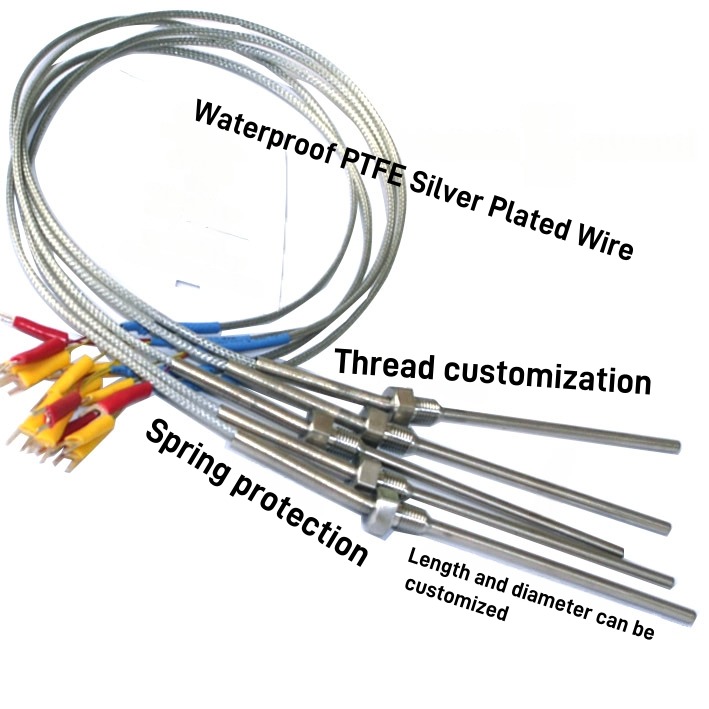
You have been let down by temperature sensors too many times. The connection vibrates loose in the middle of a critical batch. The lead wires break at the point where they enter the sensor body. Your maintenance team spends more time replacing failed sensors than doing productive work.
You are not alone. Across every industry, engineers face the same frustration. But what if there was a single sensor design that solved the most common failure points while also helping you make the right choice?
This is where this product comes in. It is a Threaded Fixed Lead Thermocouple that eliminates the weak point at the cable entry. It is a Wide Range Temperature Sensor that covers temperatures from cryogenic to high heat. And this article serves as your Industrial thermocouple selection guide to help you understand if this sensor is right for you. Let us answer the questions you are probably already asking.
Why Do Standard Thermocouples Keep Failing at the Connection Point?
Standard thermocouples have a fundamental weakness. The lead wires exit the sensor body through a simple compression fitting or an unreinforced gland. At that exit point, the wires are free to flex. Every time the equipment vibrates or the cable is moved, the wires bend at that exact same spot.
Metal work hardens when flexed repeatedly. After thousands of cycles, the thermocouple wires become brittle and crack. The signal becomes intermittent. Then it fails completely.
This product solves that problem. As a Threaded Fixed Lead Thermocouple, the lead wire is permanently molded or potted into the threaded body. The wire does not flex at a single point. The strain is distributed along the length of the strain relief. This means this Threaded Fixed Lead Thermocouple can survive thousands of flex cycles that would destroy a standard sensor.
If you are asking "Why do my sensors keep failing at the cable entry point?" the answer is that you need a Threaded Fixed Lead Thermocouple.
What Temperature Range Can This Sensor Cover?
One of the most common questions engineers ask is about temperature range. You need a single sensor that can handle your entire process, from cold startups to hot operations.
This product is a true Wide Range Temperature Sensor. Depending on the thermocouple type you choose, this Wide Range Temperature Sensor extends from cryogenic temperatures all the way to high heat.
For Type T thermocouples, this Wide Range Temperature Sensor covers from -200°C to +350°C. For Type J, this Wide Range Temperature Sensor goes from 0°C to +750°C. For Type K, which is the most popular choice, this Wide Range Temperature Sensor spans from -200°C to +1260°C. For the highest temperature applications, Type N offers coverage from 0°C to +1300°C.
If you are asking "Can one sensor cover my entire temperature measurement needs?" the answer depends on your specific range. But with the right thermocouple type, this Threaded Fixed Lead Thermocouple can handle almost any requirement. Its Wide Range Temperature Sensor capability is what makes it so versatile across different industries.
How Do I Know If This Sensor Is Right for My Application?
Selecting the correct sensor is critical. This is where this product serves as your Industrial thermocouple selection guide. Understanding the features of this Threaded Fixed Lead Thermocouple helps you decide if it fits your process conditions.
Let this be your simple Industrial thermocouple selection guide. This Threaded Fixed Lead Thermocouple is available in multiple thermocouple types. Choose Type T for cryogenic applications where you need a Wide Range Temperature Sensor down to -200°C. Choose Type J for moderate temperatures up to 750°C. Choose Type K for general purpose applications where a Wide Range Temperature Sensor from -200°C to +1260°C is needed. This is the most common choice for this Threaded Fixed Lead Thermocouple. Choose Type N for high temperature applications above 1000°C.
If you are asking "Which thermocouple type should I choose for my application?" use this Industrial thermocouple selection guide to make your decision. The Wide Range Temperature Sensor capability of this Threaded Fixed Lead Thermocouple gives you options.
What Makes the Threaded Connection So Important?
The threaded connection is not just about mounting. It is about reliability. This Threaded Fixed Lead Thermocouple screws directly into a threaded port on your equipment. The threads lock the sensor in place. It cannot pull out. It cannot vibrate loose.
Other mounting methods like compression fittings or bayonet mounts allow some movement. In high vibration environments, that movement works against you. The threaded connection of this Threaded Fixed Lead Thermocouple eliminates that variable.
For applications where the sensor is frequently removed for calibration or maintenance, the threaded connection of this Threaded Fixed Lead Thermocouple also provides consistent positioning. You remove it, then screw it back in to exactly the same depth every time.
If you are asking "What is the most secure way to mount a temperature sensor?" the answer is this Threaded Fixed Lead Thermocouple.
How Do I Install This Threaded Fixed Lead Thermocouple Correctly?
Installation is straightforward but requires attention to detail. This Threaded Fixed Lead Thermocouple screws directly into a threaded port. Use a sealant or thread tape appropriate for your temperature and pressure.
The fixed lead wire comes attached to this Threaded Fixed Lead Thermocouple. You do not need to open a connection head or wire a terminal block. Simply run the lead wire to your instrument.
The lead wire is color coded according to thermocouple standards. For a Type K Threaded Fixed Lead Thermocouple, the positive lead is yellow and the negative lead is red. Connect the wires to the correct terminals on your instrument.
If you need to extend the lead wire length, use thermocouple extension wire of the same type. Do not use standard copper wire. Copper wire will introduce errors at the connection points.
If you are asking "How do I install this sensor so it performs reliably?" the answer is clean threads, proper sealant, and correct polarity.
How Accurate Is This Threaded Fixed Lead Thermocouple?
Accuracy is always a top concern. A standard grade thermocouple in this Threaded Fixed Lead Thermocouple offers accuracy of ±0.75% or ±2.2°C, whichever is greater. Special limits of error thermocouples offer ±0.4% or ±1.1°C.
For most industrial applications, this accuracy is more than sufficient. Process control typically requires ±1°C to ±2°C. Quality control might need ±0.5°C. Safety monitoring can tolerate ±5°C or more.
If you need higher accuracy, consider an RTD instead of a thermocouple. But for general industrial temperature measurement, this Threaded Fixed Lead Thermocouple with its Wide Range Temperature Sensor capability delivers the right balance of accuracy, range, and cost.
What About Response Time? How Fast Does This Sensor React?
Response time matters when you are measuring rapidly changing temperatures. A slow sensor will miss temperature spikes. A fast sensor will catch them.
The response time of this Threaded Fixed Lead Thermocouple depends on the probe diameter and the junction type. An exposed junction responds in milliseconds. A grounded junction responds in 0.1 to 1 second. An ungrounded junction responds in 0.5 to 5 seconds.
For most industrial applications, a grounded junction offers the best balance. It is fast enough to catch most temperature changes but robust enough to survive industrial environments.
If you are asking "How fast does this sensor need to be for my process?" consider your application. For monitoring a large tank, a few seconds is fine. For monitoring an exhaust stream, you may need sub-second response.
What Are the Common Applications for This Threaded Fixed Lead Thermocouple?
This Threaded Fixed Lead Thermocouple with Wide Range Temperature Sensor capability is used across virtually every industry. Its robust construction and reliable connection make it ideal for demanding environments.
-
Plastics and rubber processing: Extruder barrel temperature monitoring. This Threaded Fixed Lead Thermocouple screws directly into the extruder head.
-
Heat treating: Furnace temperature profiling. This Threaded Fixed Lead Thermocouple survives repeated high temperature cycles.
-
HVAC: Duct temperature monitoring in commercial buildings. The threaded design of this Threaded Fixed Lead Thermocouple secures the sensor in the duct wall.
-
Power generation: Bearing temperature monitoring on turbines and generators. This Threaded Fixed Lead Thermocouple provides reliable readings in high vibration areas.
-
Food processing: Oven and dryer temperature measurement. This Threaded Fixed Lead Thermocouple withstands washdown environments.
-
Pharmaceutical manufacturing: Autoclave and sterilizer monitoring. The Wide Range Temperature Sensor capability of this Threaded Fixed Lead Thermocouple covers both sterilization and cooling phases.
-
Automotive testing: Exhaust temperature measurement on engine dynos. This Threaded Fixed Lead Thermocouple stays secure despite severe vibration.
How Long Will This Threaded Fixed Lead Thermocouple Last?
Lifespan depends on your application conditions. In a clean, low temperature environment, this Threaded Fixed Lead Thermocouple can last for decades. In a high temperature, high vibration environment, lifespan may be measured in months or years.
The failure mode is usually not the thermocouple junction itself. It is insulation breakdown or lead wire damage. High temperatures cause the insulation to become brittle. Vibration causes the lead wire to chafe against conduit.
To maximize lifespan, select the highest temperature cable insulation your budget allows. Fiberglass is good to 400°C. Ceramic fiber is good to 800°C. Mineral insulated cable is good to 1100°C.
If you are asking "How often will I need to replace this sensor?" the answer varies. But a quality Threaded Fixed Lead Thermocouple with Wide Range Temperature Sensor capability typically outlasts standard sensors by a factor of three to five.
Technical Specifications
-
Product Type: Threaded Fixed Lead Thermocouple with molded strain relief
-
Temperature Capability: Wide Range Temperature Sensor from -200°C to +1300°C depending on type
-
Selection Support: Use this Industrial thermocouple selection guide to choose the right configuration
-
Mounting: Threaded NPT, BSP, or metric threads (1/8, 1/4, 1/2 NPT; M8, M10, M12)
-
Lead Wire: Fixed, strain relieved, color coded
-
Lead Wire Length: 1m, 2m, 3m, 5m, 10m, or custom
-
Lead Wire Insulation: PVC, fiberglass, ceramic fiber, or mineral insulated
-
Junction Types: Exposed, grounded, or ungrounded
-
Accuracy: ±0.75% or ±2.2°C standard, ±0.4% or ±1.1°C special limits
-
Probe Diameter: 3mm, 6mm, 8mm, or custom
-
Probe Length: 25mm to 500mm standard
-
Response Time: τ63 < 1 second for exposed junction
Frequently Asked Questions
Q: What makes this product different from a standard thermocouple?
A: This product is a Threaded Fixed Lead Thermocouple with the lead wire permanently molded into the threaded body. It is also a Wide Range Temperature Sensor covering -200°C to +1300°C. And this article serves as your Industrial thermocouple selection guide to help you decide.
A: This product is a Threaded Fixed Lead Thermocouple with the lead wire permanently molded into the threaded body. It is also a Wide Range Temperature Sensor covering -200°C to +1300°C. And this article serves as your Industrial thermocouple selection guide to help you decide.
Q: How does the Wide Range Temperature Sensor capability help me?
A: The Wide Range Temperature Sensor capability means this Threaded Fixed Lead Thermocouple can be used across multiple temperature ranges. You can use one sensor for different applications.
A: The Wide Range Temperature Sensor capability means this Threaded Fixed Lead Thermocouple can be used across multiple temperature ranges. You can use one sensor for different applications.
Q: Is this article really an Industrial thermocouple selection guide?
A: Yes. This article provides the information you need to select the right configuration of this Threaded Fixed Lead Thermocouple. Consider it your Industrial thermocouple selection guide for this product.
A: Yes. This article provides the information you need to select the right configuration of this Threaded Fixed Lead Thermocouple. Consider it your Industrial thermocouple selection guide for this product.
Q: Can I use this Wide Range Temperature Sensor in a wet environment?
A: Yes. This Threaded Fixed Lead Thermocouple can be specified with moisture resistant potting. The Wide Range Temperature Sensor performance remains accurate.
A: Yes. This Threaded Fixed Lead Thermocouple can be specified with moisture resistant potting. The Wide Range Temperature Sensor performance remains accurate.
Q: What happens if the fixed lead wire gets cut?
A: Replace the entire Threaded Fixed Lead Thermocouple. The Wide Range Temperature Sensor capability and Threaded Fixed Lead Thermocouple design work best as a complete assembly.
A: Replace the entire Threaded Fixed Lead Thermocouple. The Wide Range Temperature Sensor capability and Threaded Fixed Lead Thermocouple design work best as a complete assembly.
Conclusion
Industrial temperature measurement does not have to be a constant battle against failed sensors. This single product is your solution. It is a Threaded Fixed Lead Thermocouple that solves the cable entry failure point. It is a Wide Range Temperature Sensor that covers everything from cryogenic to high temperature. And this article serves as your Industrial thermocouple selection guide to help you choose the right configuration.
Stop replacing sensors every month. Choose this integrated solution for your next installation.
Contact Kunlun Zhongda today. Get expert advice on selecting the right Threaded Fixed Lead Thermocouple with Wide Range Temperature Sensor capability for your application. Use this Industrial thermocouple selection guide to make an informed decision. Let us help you find a reliable partner in industrial temperature measurement.
Technical Service Hotline: 13220160485
Professional Technical Consultation: 24/7 Online Service on Official Website
View more from YouTube.
How to select products for complex industrial environments? Selection and application analysis of vibration-resistant sheathed threaded thermocouples.
How to accurately monitor water pipe temperature in harsh environments? The selection and application guide for pressure-resistant and corrosion-resistant sensors helps you tackle the challenge.
Related blog