The Ultimate Solution for HVAC System Water Pipe Temperature Monitoring Challenges: How to Choose the Right Temperature Sensor to Ensure Optimal Energy Efficiency Performance

Your chiller plant is running at full capacity, but the building is still not comfortable. Your energy bills are climbing, but you cannot pinpoint the cause. Your maintenance team keeps replacing sensors, but the readings still seem off. The building management system shows temperatures that do not match what you measure with your handheld thermometer.
Sound familiar?
HVAC water system temperature measurement is one of the most critical yet most misunderstood aspects of building energy efficiency. A small error in temperature reading can translate into a large error in energy calculation. And the wrong sensor choice can plague your system for years.
Let us answer the questions you are probably already asking.
Why Is Water Pipe Temperature Monitoring So Important in HVAC Systems?
Water carries thermal energy throughout your building. Chilled water absorbs heat from the spaces and carries it to the chiller. Hot water carries heat from the boiler to the spaces. The difference between supply and return water temperature tells you exactly how much thermal energy your system is moving.
This temperature difference, often called delta T, is the foundation of HVAC energy calculations. A delta T of 5°C versus 6°C might not seem like much. But over a year, that one degree difference can represent tens of thousands of dollars in energy waste.
If your temperature sensors are inaccurate by even 0.5°C, your delta T calculation will be wrong. Your building management system will think the system is performing one way when it is actually performing another. You will make wrong decisions about chiller staging, pump speed, and valve position.
If you are asking "Why does small temperature error matter so much?" the answer is that HVAC systems operate on small temperature differences. Small errors become large percentage errors in energy calculations.
What Is This Sensor and Why Is It the Right Choice?
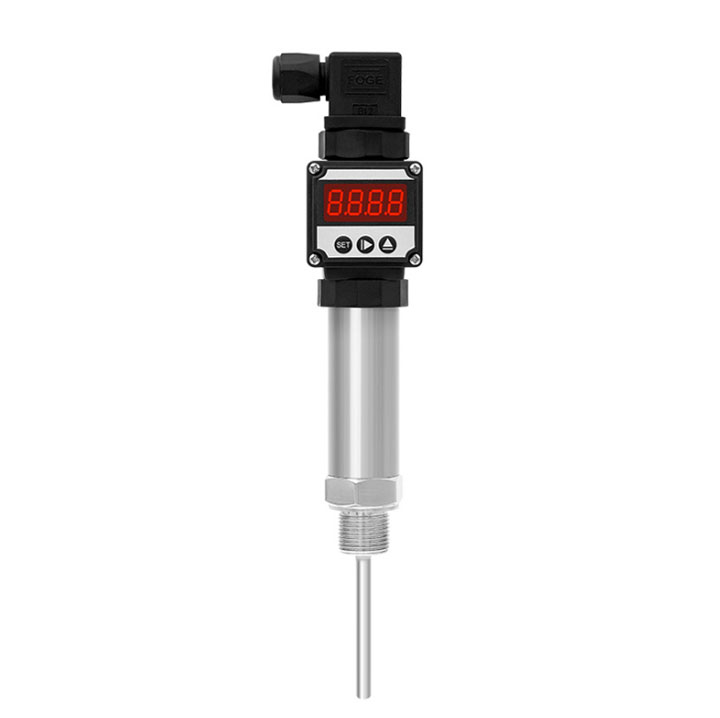
This is a single device that combines three critical features. It is an HVAC Water Pipe Temperature Sensor specifically designed for water pipe applications. It is an HVAC System Temperature Probe configured for easy installation on pipes. And it uses a PT1000 Temperature Sensor element for high accuracy and long term stability.
As an HVAC Water Pipe Temperature Sensor, this device is built for the specific demands of chilled water and hot water systems. The materials resist corrosion from treated water. The probe length is optimized for standard pipe sizes. The temperature range covers everything from freezing protection to boiler supply.
As an HVAC System Temperature Probe, this device is designed for straightforward installation. It is available in both immersion and surface mount configurations. The HVAC System Temperature Probe comes with a flexible cable that can be routed to your building management system or controller.
The core of this device is a PT1000 Temperature Sensor. A PT1000 Temperature Sensor uses platinum as the sensing element. Platinum is extremely stable over time. It does not drift like thermistors. It is more accurate than thermocouples for the temperature range of HVAC systems. The PT1000 Temperature Sensor has a nominal resistance of 1000 ohms at 0°C, which is ten times higher than a PT100. This higher resistance means that lead wire resistance has much less effect on the reading, which is critical for long cable runs in large buildings.
If you are asking "What sensor should I use for my chilled water system?" the answer is this device. It is an HVAC Water Pipe Temperature Sensor that is also an HVAC System Temperature Probe with a PT1000 Temperature Sensor inside.
Should I Use the Immersion or Surface Mount Configuration?
This is one of the most common questions. The same device is available in two mounting configurations. Your choice depends on your pipe and installation constraints.
Choose the immersion configuration of this HVAC Water Pipe Temperature Sensor when:
-
You have thermowells already installed in your pipes
-
You need the highest possible accuracy for energy metering
-
You are installing on a new system where you can add thermowells
-
The pipe is large enough to accommodate an immersion probe
Choose the surface mount configuration of this HVAC System Temperature Probe when:
-
You cannot cut into the pipe to install a thermowell
-
The system cannot be drained for installation
-
You are retrofitting an existing building
-
The pipe surface is clean and accessible
Both configurations use the same PT1000 Temperature Sensor internally. The choice is about installation method, not sensor quality. The immersion version of this HVAC Water Pipe Temperature Sensor is slightly more accurate because the sensor contacts the water directly. The surface mount version of this HVAC System Temperature Probe is more convenient for retrofits but requires careful installation for good accuracy.
If you are asking "Which mounting method is better for my building?" the answer depends on whether you are doing new construction or retrofitting an existing system.
How Do I Ensure Good Thermal Contact for Surface Mount Installation?
If you choose the surface mount version of this HVAC System Temperature Probe, good thermal contact is critical for accuracy. Here is how to do it correctly.
First, clean the pipe surface. Remove all rust, paint, and dirt. The surface should be bare metal. This HVAC Water Pipe Temperature Sensor needs direct metal to metal contact.
Second, apply thermal conductive paste. This paste fills microscopic gaps between the sensor and the pipe wall. Without paste, air gaps will reduce the accuracy of your PT1000 Temperature Sensor.
Third, strap the sensor tightly. Use stainless steel straps or zip ties rated for the pipe temperature. The HVAC System Temperature Probe must press firmly against the pipe.
Fourth, insulate over the sensor. After mounting this HVAC Water Pipe Temperature Sensor, wrap insulation around the pipe covering the sensor. This prevents ambient air from affecting the reading from your PT1000 Temperature Sensor.
A properly installed surface mount version of this HVAC System Temperature Probe can achieve accuracy within 0.2°C of an immersion sensor.
If you are asking "How can I make my surface mount sensor more accurate?" the answer is clean pipe, thermal paste, tight strap, and insulation.
What About Response Time?
Response time is important but often overemphasized for HVAC water systems. Water temperatures in pipes do not change rapidly. Chilled water might change 1°C over several minutes. Hot water might change 2°C over several minutes.
The immersion version of this HVAC Water Pipe Temperature Sensor has a response time of 5 to 15 seconds. The surface mount version of this HVAC System Temperature Probe has a response time of 15 to 30 seconds.
Both are fast enough for HVAC control and monitoring. Your chiller plant does not need millisecond response. What you need from your PT1000 Temperature Sensor is accuracy and stability, not speed.
If you are asking "Is this sensor fast enough for HVAC control?" the answer is yes. Focus on the PT1000 Temperature Sensor accuracy, not response time.
How Do I Handle Long Cable Runs?
Long cable runs are common in large buildings. The chiller plant might be in the basement, and the sensors are on the 20th floor. Lead wire resistance becomes a real problem.
This is where the PT1000 Temperature Sensor feature of this device shines. A standard PT100 sensor has only 100 ohms of resistance at 0°C. The PT1000 Temperature Sensor in this device has 1000 ohms. The higher resistance means that lead wire resistance has proportionally less effect.
For a two wire PT1000 Temperature Sensor, a 100 meter cable might add 2 ohms of resistance. For a PT1000, 2 ohms equals about 0.5°C of error. For a PT100, the same cable would cause 5°C of error.
For even better accuracy, this HVAC System Temperature Probe can be ordered in a three wire configuration. A three wire PT1000 Temperature Sensor cancels out lead wire resistance entirely.
If you are asking "How do I get accurate readings over long distances?" the answer is to use this HVAC Water Pipe Temperature Sensor with its PT1000 Temperature Sensor element, preferably in a three wire configuration.
Can I Use the Same Sensor for Both Supply and Return?
Yes. You should use identical sensors for supply and return. This is critical for delta T accuracy.
If you use this HVAC Water Pipe Temperature Sensor on the supply and a different type on the return, any offset between the two sensors will appear as a delta T error. Even if both sensors are within their individual accuracy specifications, the difference between them could be as much as 0.6°C.
For best results, use matched pairs. Order two of these HVAC System Temperature Probe devices from the same batch. Better yet, have them calibrated together so you know the offset between them. The PT1000 Temperature Sensor inside each unit will be very consistent from unit to unit.
If you are asking "Why do I need the same sensor on supply and return?" the answer is that matched sensors cancel out common mode errors.
What About Sensor Placement?
Sensor placement is often overlooked but critically important for this HVAC Water Pipe Temperature Sensor.
Install the HVAC System Temperature Probe where the water is well mixed. Avoid locations near:
-
Pump inlets and outlets (turbulence and stratification)
-
Elbows and tees (unmixed flow)
-
Immediately after heating or cooling coils (stratification)
-
Dead legs or low flow areas (stagnant water)
Good locations are:
-
At least 5 pipe diameters downstream of any fitting
-
On straight sections of pipe with fully developed flow
-
After a mixing section or static mixer
For chilled water systems, install this HVAC Water Pipe Temperature Sensor on the suction side of the pump where possible. The water is well mixed here, and your PT1000 Temperature Sensor will give you the most representative reading.
If you are asking "Where should I put my temperature sensor?" the answer is in a straight pipe section with well mixed flow, away from pumps and fittings.
How Do I Know If My Existing Sensors Are Accurate?
You suspect your sensors are wrong but you are not sure. Here is how to check this HVAC System Temperature Probe.
First, use a calibrated handheld thermometer with an immersion probe. Insert it into a thermowell near your installed sensor. Compare the readings to your PT1000 Temperature Sensor.
Second, check for consistency. If you have multiple of these HVAC Water Pipe Temperature Sensor devices on the same system, they should read similar temperatures when the system is at steady state. Large differences indicate a problem.
Third, check for drift over time. Log the readings from your PT1000 Temperature Sensor at a fixed condition. If the reading changes slowly over weeks or months, the sensor may be drifting.
Fourth, perform an ice bath test. Insert the probe of this HVAC System Temperature Probe into an ice water slurry. Your PT1000 Temperature Sensor should read 0°C ±0.3°C. This is a simple field check.
If you are asking "How can I test my sensors in the field?" the answer is ice bath test for zero point, and comparison with a calibrated reference for other points.
Technical Specifications
-
Product Identity: Single device that is an HVAC Water Pipe Temperature Sensor, an HVAC System Temperature Probe, and a PT1000 Temperature Sensor
-
Sensing Element: Platinum RTD, 1000 ohms at 0°C – true PT1000 Temperature Sensor
-
Application Focus: Designed as HVAC Water Pipe Temperature Sensor for chilled and hot water
-
Configuration: Available as immersion or surface mount HVAC System Temperature Probe
-
Accuracy: Class B ±0.3°C at 0°C, Class A ±0.15°C at 0°C
-
Temperature Range: -50°C to +150°C
-
Stability: <0.05°C drift per year
-
Connection: Two wire or three wire
-
Immersion Length: 50mm to 200mm
-
Surface Mount: Spring loaded strap mount with thermal paste
-
Response Time: τ63 <10 seconds for immersion, <25 seconds for surface mount
-
Protection Rating: IP65 for connection head, IP68 for probe
-
Cable: Shielded, PVC or PTFE insulated
Frequently Asked Questions
Q: What is this product? Does it have multiple names?
A: Yes. This is one product. It is an HVAC Water Pipe Temperature Sensor because it is designed for water pipes. It is an HVAC System Temperature Probe because it is configured as a probe for system monitoring. And it uses a PT1000 Temperature Sensor as its sensing element. One device, three descriptive names.
A: Yes. This is one product. It is an HVAC Water Pipe Temperature Sensor because it is designed for water pipes. It is an HVAC System Temperature Probe because it is configured as a probe for system monitoring. And it uses a PT1000 Temperature Sensor as its sensing element. One device, three descriptive names.
Q: Why is the PT1000 Temperature Sensor better than PT100 for this application?
A: The PT1000 Temperature Sensor has ten times higher resistance at 0°C. This makes it much less sensitive to lead wire resistance, which is important for long cable runs in large buildings.
A: The PT1000 Temperature Sensor has ten times higher resistance at 0°C. This makes it much less sensitive to lead wire resistance, which is important for long cable runs in large buildings.
Q: Can I use this HVAC System Temperature Probe for both hot water and chilled water?
A: Yes. The PT1000 Temperature Sensor inside covers the full range from chilled water to boiler water. Just ensure the probe material is compatible with your water chemistry.
A: Yes. The PT1000 Temperature Sensor inside covers the full range from chilled water to boiler water. Just ensure the probe material is compatible with your water chemistry.
Q: How long does this HVAC Water Pipe Temperature Sensor last?
A: A quality HVAC Water Pipe Temperature Sensor with a PT1000 Temperature Sensor inside can last 10 to 15 years or more. The platinum element does not degrade.
A: A quality HVAC Water Pipe Temperature Sensor with a PT1000 Temperature Sensor inside can last 10 to 15 years or more. The platinum element does not degrade.
Q: Do I need to calibrate this HVAC System Temperature Probe?
A: Factory calibration is included. For critical energy metering, annual verification is recommended. The PT1000 Temperature Sensor is very stable, so many building owners calibrate every two to three years.
A: Factory calibration is included. For critical energy metering, annual verification is recommended. The PT1000 Temperature Sensor is very stable, so many building owners calibrate every two to three years.
Conclusion
Contact Kunlun Zhongda today. Get expert advice on selecting the right configuration of this HVAC Water Pipe Temperature Sensor, HVAC System Temperature Probe, and PT1000 Temperature Sensor integrated solution for your building. Let us help you achieve optimal energy efficiency performance.
Technical Service Hotline: 13220160485
Professional Technical Support: Online Consultation Service on Official Website
View more from YouTube.
How to measure temperature in complex working conditions? Integrated insertion sensors achieve precise monitoring.
Still Troubled by Inaccurate Temperature Monitoring in Your Air Conditioning System? Multi-Interface Temperature Sensors Provide the Solution
Related blog