Home /Blog /Sensor Encyclopedia /How to Choose Between Air Duct & In-Pipe Sensors? Kunlun Zhongda Provides an In-Depth Analysis /
How to Choose Between Air Duct & In-Pipe Sensors? Kunlun Zhongda Provides an In-Depth Analysis
In Building Automation Systems (BAS) and industrial process control, accurately measuring air temperature and humidity is critical for energy efficiency and environmental comfort. However, faced with the choice between air duct and in-pipe sensors, many engineers and procurement managers often feel confused. Choosing the wrong sensor type can lead to inaccurate data, reduced system efficiency, or even equipment damage.
This article focuses on a core product—the air duct temperature and humidity sensor—which integrates the functions of a Temperature and Humidity Transmitter and supports RS485 temperature and humidity transmitter communication, to help you make the smartest decision.
1. Core Difference: Application Scenario Dictates the Fundamental Choice
The first step in selection is always to clarify the installation environment.
Air Duct Sensors: Suitable for Open or Semi-Open Spaces
Typical Scenarios: Air conditioning return air vents, server rooms, warehouses, factory floors, cleanrooms—areas requiring monitoring of overall ambient conditions.
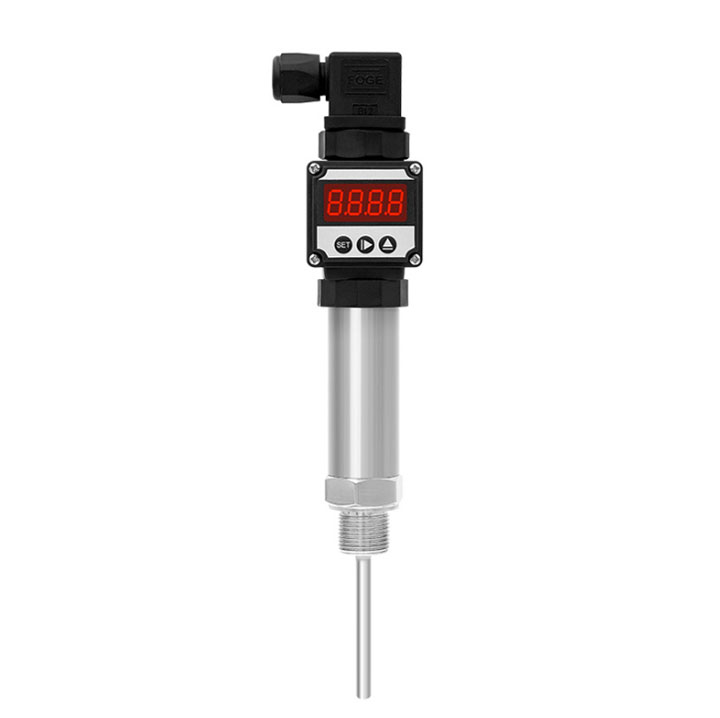
Characteristics: The sensor is directly exposed to flowing air, monitoring the state of the "space." For example, Kunlun Zhongda's flange and threaded installation air duct temperature and humidity sensor, with its lightweight and robust design, is well-suited for such applications. This sensor is equipped with a built-in Temperature and Humidity Transmitter that converts temperature and humidity signals into standard 4-20mA or 0-10V outputs, making it compatible with most PLCs and DCS systems.
In-Pipe Sensors: Suitable for Enclosed Airflow Environments
Typical Scenarios: HVAC supply/return air ducts, industrial process pipes, inside air handling units (AHUs).
Characteristics: The sensor must be embedded inside the duct to make direct contact with the core airflow, monitoring the state of the air "in transit."
2. Comparison of Five Key Decision-Making Factors
Beyond the application scenario, the following five factors will directly influence your choice:
Accuracy and Response Speed
In-Pipe Typically Superior: Due to direct contact with stable, high-velocity core airflow, they generally offer higher accuracy (e.g., ±0.3°C/±1.5% RH) and faster response times (<5s). The air duct temperature and humidity sensor, when equipped with an RS485 temperature and humidity transmitter module, provides digital transmission with strong anti-interference capability, making it ideal for electrically noisy environments.
Air Duct Considers Environmental Interference: In open spaces, measurement can be affected by edge airflows, door openings, etc., leading to slightly lower accuracy (e.g., ±0.5°C/±2% RH). However, the built-in Temperature and Humidity Transmitter ensures long-distance signal transmission remains stable.
Environmental Adaptability and Protection Rating (IP)
Air Duct Focus: Requires emphasis on dust prevention (IP65) and condensation prevention. In high-humidity environments, select models with heating functions to prevent condensation on the sensor surface. The RS485 temperature and humidity transmitter version supports Modbus RTU protocol, allowing daisy-chaining of multiple sensors on a single bus, which greatly reduces wiring complexity.
In-Pipe Focus: Must consider pressure resistance and ability to withstand airflow impact to ensure long-term stability under positive/negative duct pressure and high airflow velocity.
Installation and Maintenance Costs
Installation Complexity:
-
In-Pipe: Requires drilling into the duct, welding, or flange fixation, involving more engineering effort and higher installation costs.
-
Air Duct: Typically uses clips or screws for fixation, making installation simpler and quicker. The air duct temperature and humidity sensor with RS485 temperature and humidity transmitter connectivity reduces wiring, further lowering installation costs.
Maintenance Convenience:
-
Air Duct: Easy to clean or calibrate on-site.
-
In-Pipe: Maintenance may require disassembly or depends on pre-installed access ports, which can be more troublesome.
Handling Extreme Conditions
In harsh environments with low temperatures (<0°C) or persistently high humidity (>90% RH), in-pipe sensors more readily accommodate the addition of protective wells or heating modules. The RS485 temperature and humidity transmitter variant maintains reliable digital communication even under extreme electrical interference.
Overall Cost Considerations
Initial Cost: In-pipe sensors and their associated installation parts are usually more expensive.
Long-term Cost: The air duct temperature and humidity sensor with built-in Temperature and Humidity Transmitter offers lower total cost of ownership due to simpler installation and maintenance.
Long-term Cost: The air duct temperature and humidity sensor with built-in Temperature and Humidity Transmitter offers lower total cost of ownership due to simpler installation and maintenance.
3. Key Feature: Why Choose the RS485 Temperature and Humidity Transmitter Version?
The RS485 temperature and humidity transmitter is a specialized variant of the air duct temperature and humidity sensor that offers:
-
Modbus RTU Communication: Industry-standard protocol for seamless integration with building automation systems.
-
Multi-Sensor Networking: Connect up to 32 sensors on a single bus, significantly reducing wiring and installation costs.
-
Long-Distance Transmission: Reliable data transmission up to 1200 meters without signal degradation.
-
High Anti-Interference: RS485 differential signal transmission ensures data integrity in electrically noisy environments.
4. Conclusion and Recommendations
Making the final choice is straightforward when you align the sensor's strengths with your primary need.
Choose the Air Duct Temperature and Humidity Sensor if your goal is to monitor the overall environmental conditions of a space, such as a room, server room, or warehouse. This type is the preferred option when your priorities are flexible installation, simpler maintenance, and lower overall cost.
The built-in Temperature and Humidity Transmitter ensures stable signal transmission, while the RS485 temperature and humidity transmitter version provides digital communication advantages for large-scale systems.
Opt for the In-Pipe Sensor if your application requires precise measurement of the air within a duct or pipe, such as for controlling supply air parameters or a specific industrial process.
5. What's the Next Step?
If you are still unsure about the right choice for your specific project, please feel free to contact our technical experts. We will provide free, personalized selection advice and technical support based on your actual working conditions, budget, and measurement requirements.
View more from YouTube.
Click to view KLZD home>>
Release time: 2025-08-11
Beyond Numbers: How an Industrial LCD Temperature & Humidity Transmitter Safeguards Your Critical Environments
Related blog