
Technical Iteration and Domestic Substitution Trend of Pressure Sensors and Pressure Transmitters
author: KLZD
2026-06-30
Industry In-depth Article 2026: Development Status, Technical Iteration and Domestic Substitution Trend of Pressure Sensors and Pressure Transmitters
I. Industry Overview: Two Products Form a Complete Industrial Pressure Measurement System
In the track of intelligent manufacturing and process industrial automation, pressure sensors and pressure transmitters are two core hardware for pressure detection. Although they have long been confused in the industry, they differ fundamentally in positioning, structure and application scope, jointly supporting pressure monitoring demands across petrochemical, new energy, power, water treatment, semiconductor, construction machinery and all other industries.
Simple classification:
- Pressure Sensor: The core pressure-sensing chip, only completing the conversion from pressure to original millivolt/resistance signals without standardized signal processing. It features compact size, mostly used for embedded OEM, dynamic testing and close-range built-in equipment detection.
- Pressure Transmitter: Built around pressure sensors, integrated with amplifying circuits, temperature compensation, linear correction and isolation circuits. It outputs standard industrial signals including 4-20mA, HART and RS485 digital signals, equipped with metal explosion-proof housings and standardized waterproof connectors. Suitable for long-distance wiring, harsh industrial sites and centralized control systems of PLC/DCS, it is standard instrumentation for process factories.
II. Global Market Scale & Demand Structure 2026 (Authoritative Industrial Data)
According to the latest 2026 June industrial statistics from GEP and Mordor Intelligence:
- The overall global market of pressure sensors and transmitters reached USD 7.82 billion in 2025, projected to exceed USD 8.3 billion in 2026 with an average annual growth rate of 6.5%. Among them, the industrial transmitter segment recorded a market size of USD 3.32 billion, with a CAGR of 3.38% from 2026 to 2031.
- China is the world’s largest production and consumption market. Its domestic market scale surpassed RMB 12 billion in 2025, accounting for 32% of the global total and growing 1.4 percentage points faster than the global average. High-precision transmitters (accuracy ≤0.075%FS) have risen to 35% of the market share, the fastest-growing subdivision.
- Four core tracks drive market demand: new energy (lithium battery, photovoltaic energy storage, hydrogen energy), petrochemical industry, thermal power & new power, municipal water treatment. The penetration rate of wireless intelligent multi-variable transmitters has exceeded 55%, gradually replacing traditional analog transmitters.
Terminal Industry Demand Breakdown
- Oil & Petrochemical Industry: 31% market share, dominated by high-temperature explosion-proof and corrosion-resistant differential pressure transmitters for wellheads, reactors and pipeline safety monitoring.
- Lithium Battery & Hydrogen New Energy: Highest growth rate (14% year-on-year), matched with miniature MEMS pressure sensors and compact hygienic transmitters.
- Water Supply & Environmental Protection: 18% market share, large quantities of general pressure transmitters deployed for pipeline leakage detection and pump station constant pressure control.
- High-end Manufacturing & Semiconductors: High-precision ceramic/silicon resonant sensors for precise measurement of vacuum and micro-pressure.
III. Core Technical Iteration Trends (2026 Hot Industrial Technologies)
1. Dual Upgrade of Sensing Chip Technology
- MEMS Miniature Sensors: Continuous reduction in mass production cost, miniaturization and low power consumption for embedded installation in vehicles and energy storage equipment. Fiber-optic pressure sensors are gradually applied to high-end vacuum and strong electromagnetic interference scenarios.
- Silicon Resonant Intelligent Chips: New-generation high-precision chips promoted by Yokogawa, domestic Chuanyi and Supcon reduce long-term zero drift by 60% and extend calibration cycles to 24 months, greatly cutting factory operation and maintenance costs.
2. Intelligence & Wireless Connection Become Standard for Transmitters
New industrial products launched in 2026 uniformly support three core capabilities:
- HART/WirelessHART digital protocols for remote parameter adjustment and self-diagnosis of faults;
- Integrated multi-variable measurement: single transmitters simultaneously measure pressure, temperature and differential pressure to replace multiple instruments and lower field wiring costs;
- IIoT cloud access to realize predictive maintenance, matching digital transformation demands of factories.
3. Breakthroughs in Domestic Materials & Manufacturing Processes
High-precision silicon chips and special ASIC chips long relied on imports from Europe, America and Japan. From 2025 to 2026, leading domestic instrumentation enterprises completed mass production of diffused silicon and ceramic sensitive elements. Domestic transmitters stably achieve an accuracy of 0.1%FS, with the import substitution rate exceeding 70% in mid-to-low-end markets. However, technical gaps remain in ultra-high-precision products below 0.05%FS and core explosion-proof chips.

IV. Core Selection Differences Between Pressure Sensors and Transmitters (Engineering Application Guide)
| Comparison Dimension | Pressure Sensor | Pressure Transmitter |
|---|---|---|
| Output Signal | Original millivolt/resistance signals without unified standards | Standard industrial signals: 4-20mA, 0-10V, HART, RS485 |
| Transmission Distance | ≤5 meters, susceptible to electromagnetic interference | Stable transmission over kilometers with anti-interference and lightning protection isolation |
| Appearance & Structure | Miniature patch/lead structure without protective housing | Metal explosion-proof housing, optional display head, standard flanged/threaded mounting joints |
| Stability | No aging calibration, severe temperature drift | Factory aging test + full-temperature compensation, minimal long-term drift |
| Application Scenarios | Laboratory dynamic testing, OEM instruments, built-in consumer equipment | Chemical industry, power plants, pipelines, tanks, explosion-risk industrial sites |
| Comprehensive Cost | Low unit price, extra amplifying circuits required | Integrated complete machine, lower overall cost for field construction and maintenance |
V. Industry Pain Points & Development Opportunities
Industry Pain Points
- Severe homogenization in low-end market: numerous manufacturers only assemble outsourced chips without self-developed sensitive elements, triggering price wars and shrinking profit margins.
- Bottlenecks in high-end segments: ultra-high-precision sensing chips, industrial special ASICs and core explosion-proof certification technologies are monopolized by Emerson, Yokogawa and Siemens.
- Rising customized demands across industries: long delivery cycles for small-batch non-standard products, insufficient flexible production capacity among small and medium manufacturers.
Long-term Development Opportunities
- Policy support for new industrialization: Intelligent manufacturing plans during the 15th Five-Year Plan, petrochemical industry upgrading and urban pipeline reconstruction continuously generate purchasing demands for millions of measuring instruments.
- Blue ocean incremental market in new energy: Explosive demands for miniature, hygienic and explosion-proof pressure measuring equipment from hydrogen energy storage & transportation, lithium battery production lines and energy storage liquid cooling systems.
- Huge stock replacement market: Massive instrumentation equipment commissioned before 2010 in domestic factories has entered replacement cycles, with broad room for intelligent transmitters to replace traditional analog devices.
- Expanding overseas market: Accelerated industrial infrastructure construction in Southeast Asia, the Middle East and Latin America. Domestic transmitters gradually replace imported European and American brands with cost-performance advantages.
VI. 5-Year Industry Forecast (2026–2030)
- Product Level: Integrated sensing & transmission products will become mainstream, blurring the boundary between sensors and transmitters. Wireless, multi-parameter and self-calibrating intelligent instruments will account for over 80% of the market.
- Competition Pattern: Leading domestic enterprises (Chuanyi, Supcon, KLZD, etc.) continuously break through high-precision segments, while market shares of foreign brands shrink year by year. Small manufacturers without independent R&D capacity in low-end markets will exit the industry rapidly.
- Technical Direction: Fiber-optic pressure sensing, low-temperature superconducting micro-pressure measurement and built-in AI fault prediction will become core competitiveness of high-end products.
- Market Scale: China’s pressure sensor and transmitter market is expected to exceed RMB 20 billion by 2030, with the domestic substitution rate rising above 85%.
VII. Industry Summary
Pressure sensors are the underlying core of perception, while pressure transmitters are complete terminals for industrial implementation. The two are not substitutes but upstream and downstream supporting products. In 2026, the industry stands at a dual window of independent technology research & development and digital transformation. Sustained expansion of downstream new energy and process industries brings market growth momentum. Domestic manufacturers seize market share relying on cost and service advantages. Only enterprises that deepen independent R&D of sensing chips and deploy IoT intelligent technology can avoid vicious low-end price competition and capture long-term industrial dividends.
Accurate Temperature Sensing, Empower Full-Scenario Intelligent Monitoring — High-Precision Temperature Sensors
Thermocouple Temperature Sensor Company: Precision Temperature Measurement, Leading Industry Innovation and Development
Related Article

Results indicate that fluoride ion electrode in the system offers fast response and high accuracy, effectively reducing chemical costs and enhancing process automation to ensure compliant industrial wastewater discharge.
Application of Fluoride Ion Electrodes in Semiconductor Industry Wastewater Treatment
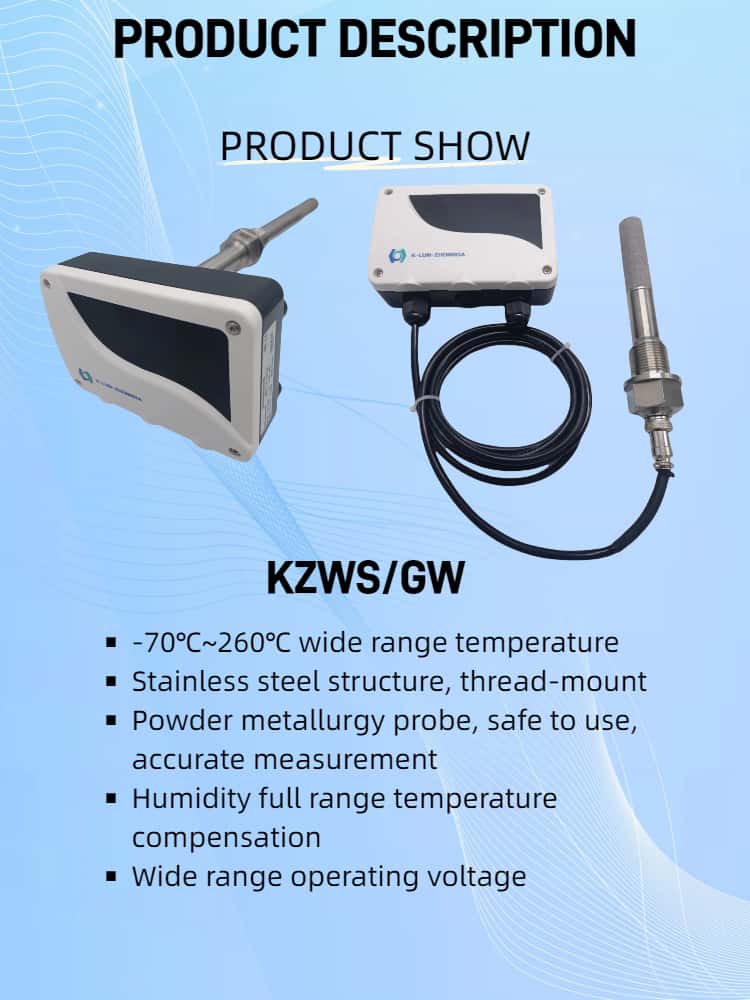
The Kunlun Zhongda high temperature and humidity transmitters are the key hardware foundation for transitioning wood drying kilns from experience-based drying to precision drying. The high temperature adaptability, anti-condensation design, and industrial grade stability directly determine the intelligence level of the drying process and the quality of the final product.
Application of Kunlun Zhongda High Temperature and Humidity Transmitter in Wood Drying Kilns

The deep value of screw pump temperature sensors lies not in single point measurement but in a four-in-one system including transient protection, stator smart algorithm, triangular fusion diagnostics and SIL functional safety, which enable most component suppliers to upgrade to system solution providers.
Applications of Temperature Sensors in Screw Pumps

From passive alarm to proactive prediction, from single-point measurement to multi-parameter fusion, that is the technical foundation for the shift from "scheduled maintenance" to "predictive maintenance" by using temperature sensors in multistage high pressure pumps.
Application of Temperature Sensors in Multistage High Pressure Pumps