
From "Vague Requirements" to "Precise Matching": How a Sensor Sale Evolved into a New Paradigm of Technical Cooperation
author: jennie
2026-01-30

In an era where B2B sales cycles are widely considered lengthy and decision-making chains complex, a recent transaction completed by Beijing Kunlun Zhongda Sensor Technology Co., Ltd. demonstrates a strikingly different possibility—not waiting for customers to provide complete technical specifications, but proactively becoming the definer of customers' technical needs. This case not only successfully sold a batch of Platinum Resistance Temperature Sensor Customization products but also reveals deeper trends in the transformation of Chinese manufacturing from "product supply" to "collaborative solution provision."
The beginning of the story was quite common: Beijing Shenzhou Co., Ltd. posted an inquiry for Industrial Grade Temperature Sensor products through the corporate website. Most suppliers' standard practice would be to reply with a quotation and wait for the customer to specify the exact model. However, Kunlun Zhongda's sales engineers noticed a critical detail during initial communication—the customer provided clear descriptions of the equipment the sensors needed to match but were quite vague about the sensors' technical specifications.
"We realized this wasn't a simple pricing inquiry but that the customer was at a critical juncture of equipment upgrading, needing a technical partner rather than just a component supplier," recalled the technical manager in charge of the project. Instead of following the traditional approach of waiting for customers to research parameters independently, Kunlun Zhongda decided on the same day to dispatch an engineering team to the customer's site.
This decision, which seemed to increase costs, became the turning point of the entire collaboration. At the customer's production workshop, the engineers not only inspected the equipment to be matched but also gained an in-depth understanding of the entire process flow: the sensor installation point experienced periodic vibration, the measured medium had slight corrosiveness, and the control system had special requirements for signal response speed—critical information completely absent from the initial requirement description.
The real innovation occurred during the parameter determination phase. Platinum Resistance Temperature Sensor Customization was not about simply providing an existing product catalog. Instead, based on on-site data, they designed a "non-standard parameter combination" for the customer: building upon conventional platinum resistance sensors, they added Vibration-Resistant Temperature Sensor anti-vibration structural design, adopted special encapsulation materials to resist corrosion, and optimized signal output interfaces to match the customer's control system. Three days later, when they reappeared at the customer's site with freshly assembled samples, the reaction of the customer's technical team shifted from surprise to approval.
Test Results Exceeded Expectations: 72-Hour Validation of the Industrial Grade Temperature Sensor
The test results exceeded expectations. During 72 hours of continuous comparative experiments, this batch of Industrial Grade Temperature Sensor products not only fully met all indicators but even surpassed the stability of the imported brand products the customer previously used in vibration environments. More valuable, however, was the subsequent service response: based on initial installation data, Kunlun Zhongda's Vibration-Resistant Temperature Sensor solution also proactively provided calibration suggestions for the sensors under different working conditions and assisted the customer in optimizing installation procedures.
"We originally thought we were just buying a few sensors, but we unexpectedly received a complete temperature measurement solution," stated the project manager of Beijing Shenzhou Co., Ltd. in an interview. This cooperation not only addressed immediate technical needs but, more importantly, established a new collaboration model—suppliers are no longer passively responding to orders but are becoming participants and enablers in the customer's technological upgrading process.
From Product to Solution: Deep Trust Built Through Platinum Resistance Temperature Sensor Customization
The order materialized naturally, but its significance extends far beyond that. Based on the technical mutual trust established through this experience, both parties have now begun exploring deep cooperation in intelligent transformation projects. Kunlun Zhongda is assisting the customer in integrating composite monitoring functions for temperature and vibration into their next-generation equipment, which goes far beyond the initial scope of simple Industrial Grade Temperature Sensor procurement.
This case reflects an important trend: In specialized fields like Platinum Resistance Temperature Sensor Customization, Industrial Grade Temperature Sensor, and Vibration-Resistant Temperature Sensor, customer needs are shifting from "clear procurement" to "problem-solving." Suppliers who can help customers clarify vague requirements and provide systematic technical support are reshaping traditional value chain relationships. They are selling not only products but also the ability to understand customer process flows and the responsiveness of technical collaboration.
Conclusion: From "Made in China" to "Serviced by China"
Beijing Kunlun Zhongda's two-decade development journey precisely witnesses the transformation of China's industrial sensor sector from imitation to innovation, from manufacturing to service. From initially supplying standardized products to now being able to quickly customize Platinum Resistance Temperature Sensor Customization, Industrial Grade Temperature Sensor, and Vibration-Resistant Temperature Sensor based on customers' on-site working conditions, this capability is underpinned by the company's sustained investment in R&D—possessing dedicated working-condition laboratories, complete material testing systems, and, more importantly, a technical team capable of understanding real needs at customer sites.
Against the backdrop of current manufacturing upgrades, this seemingly ordinary sensor sales case actually reveals a microcosm of the transformation from "Made in China" to "Serviced by China." As more Chinese enterprises begin climbing to the high end of the industrial chain, the demand for companies like Kunlun Zhongda will no longer be limited to the products themselves but will require them to become "technical translators" and "solution co-builders" in the manufacturing upgrading process.
Starting from a vague inquiry to establishing long-term technical cooperation, the core insight of this story might be: in today's industrial goods market, the greatest business opportunities often hide within customers' "hard-to-articulate" needs, and true competitiveness lies in the ability to understand customers' real application scenarios better than they do themselves.
View more from YouTube.
Smart Agriculture Revolution: Kunlun Zhongda Launches Fully Wireless Remote Greenhouse Monitoring System, Ushering in an Era of Precision Farming
From "Replacement" to "Surpassing": The 20-Year Overtaking Journey of a Chinese Sensor Enterprise
Related Article
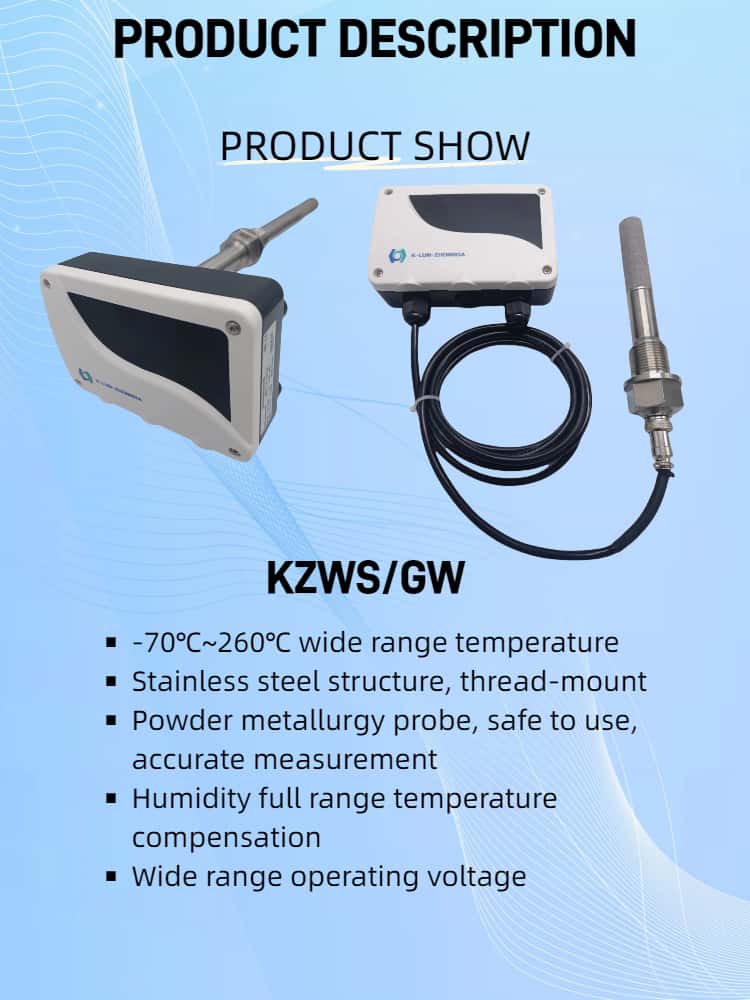
The Kunlun Zhongda high temperature and humidity transmitters are the key hardware foundation for transitioning wood drying kilns from experience-based drying to precision drying. The high temperature adaptability, anti-condensation design, and industrial grade stability directly determine the intelligence level of the drying process and the quality of the final product.
Application of Kunlun Zhongda High Temperature and Humidity Transmitter in Wood Drying Kilns

The deep value of screw pump temperature sensors lies not in single point measurement but in a four-in-one system including transient protection, stator smart algorithm, triangular fusion diagnostics and SIL functional safety, which enable most component suppliers to upgrade to system solution providers.
Applications of Temperature Sensors in Screw Pumps

From passive alarm to proactive prediction, from single-point measurement to multi-parameter fusion, that is the technical foundation for the shift from "scheduled maintenance" to "predictive maintenance" by using temperature sensors in multistage high pressure pumps.
Application of Temperature Sensors in Multistage High Pressure Pumps

The value of temperature sensor monitoring lies not in "knowing the current temperature" but in "predicting what it will become",from passive alarm to proactive prediction, this is the technical foundation of the shift from scheduled to predictive maintenance.
Application of Temperature Sensors in Centrifugal Pumps