
How Can Industrial Ovens Achieve Precise Dual Temperature and Humidity Control? Why Did a Shanghai Equipment Manufacturer Choose Kunlun Zhongda?
author: jennie
2025-12-05

[Beijing, Recent] In industrial sectors such as food processing, electronic drying, and material curing, what unique challenges does the process control of hot air ovens face? When temperature requirements reach 200°C or even higher, how can the accuracy of humidity measurement and the long-term reliability of sensors be ensured? Recently, a professional equipment manufacturing enterprise in Shanghai consulted Beijing Kunlun Zhongda Sensor Technology Co., Ltd. regarding the temperature and humidity monitoring needs for hot air ovens. The client clearly specified a measurement temperature below 200°C and a humidity range between 30% RH and 80% RH. Behind this seemingly routine inquiry lies a long-standing technical challenge in the field of industrial sensing: achieving stable and accurate humidity measurement in sustained high-temperature environments.
High-Temperature Humidity Measurement: Why Has It Become a "Technical Barrier" for Many Sensor Manufacturers?
"The main challenge for temperature and humidity sensors used in ovens is measuring humidity at high temperatures," a Kunlun Zhongda Technical Director pinpointed the industry's pain point. Most standard humidity sensors are based on capacitive or resistive principles, and their core sensing elements are highly susceptible to performance degradation, material aging, or even failure under continuous high temperatures. When the internal temperature of an oven is consistently maintained above 150°C, the vast majority of commercial humidity sensors can no longer guarantee data accuracy, let alone operate stably at 200°C or higher. This has led many oven manufacturers to either abandon humidity monitoring or resort to indirect, lagging estimation methods.
However, for many precision processes, humidity is as critical as temperature. For instance, in high-end baking or electronic component drying, excessive humidity can lead to reduced product quality, while insufficient humidity may cause cracking or electrostatic issues. The inquiry from the Shanghai client represents the market's urgent need for sensors capable of directly and reliably measuring humidity under real high-temperature operating conditions.
Nearly Two Decades of Technical Expertise: How Has Kunlun Zhongda Overcome the Challenge of High-Temperature, High-Humidity Measurement?
"For general manufacturers, it might not be easy, but for Kunlun Zhongda, this problem was solved long ago," stated the company's R&D lead. Leveraging nearly two decades of continuous R&D in specialized temperature and humidity sensing, Kunlun Zhongda has successfully developed a series of high-temperature temperature and humidity sensors capable of long-term stable operation in environments up to 300°C through systematic innovation in sensitive materials, encapsulation processes, and compensation algorithms.
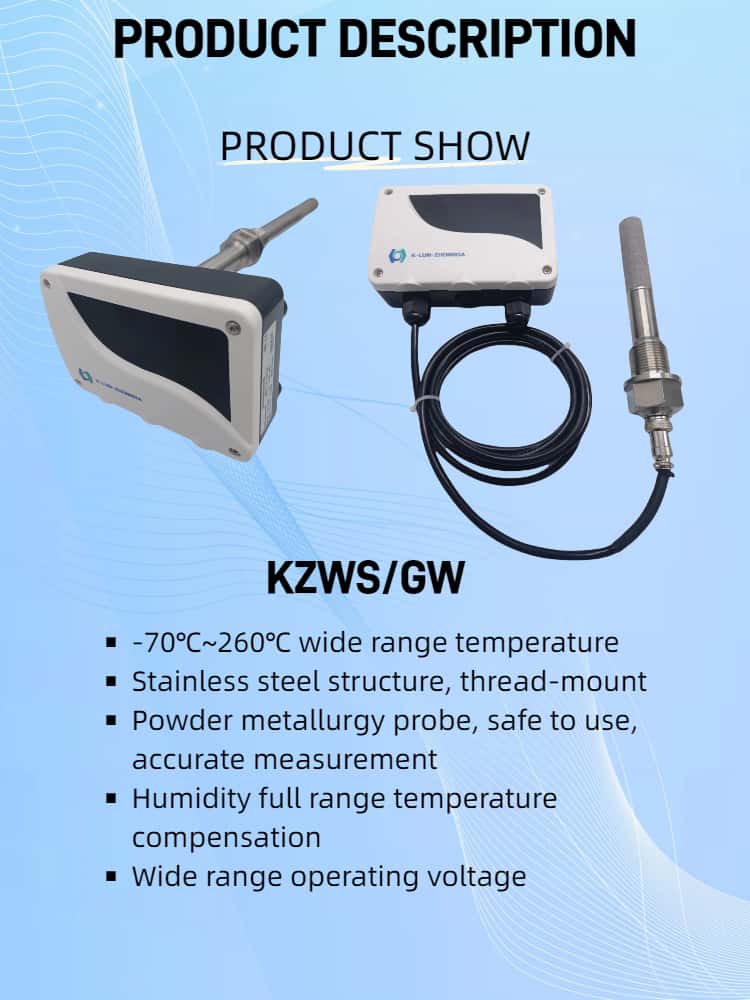
The core technology of this product series lies in its unique high-temperature-resistant humidity-sensing elements and integrated encapsulation design. The sensor is not simply a bundled combination of a temperature probe and a humidity probe; instead, it addresses mutual interference and long-term drift issues in high-temperature, high-humidity coexistence environments at the material level. This enables the sensor to provide accurate, real-time temperature and humidity data even under the direct impact of high-temperature airflow inside the oven, making closed-loop process control possible for clients.
From Inquiry to Trust: How Do Domestic High-End Sensors Gain Recognition from Shanghai Manufacturers?
After receiving clear technical affirmation and parameter matching, the Shanghai client's decision-making logic became evident: on the basis of meeting functional requirements (temperature and humidity measurement below 200°C), Kunlun Zhongda's product, with its measurement margin of up to 300°C, provided additional assurance for the safety and reliability of their equipment. More importantly, compared to the few imported brands capable of offering similar performance, Kunlun Zhongda holds significant advantages in terms of product cost-effectiveness, delivery lead times, and localized technical support.
Empowering Intelligent Industrial Ovens: The Sensor's Role Extends Beyond Measurement
The engagement with the Shanghai client is a microcosm of Kunlun Zhongda's deep expertise in the industrial specialty sensing market. For over two decades, the company has focused on high-temperature temperature and humidity sensors, duct-mounted ambient temperature and humidity sensors, and deep customization products, maintaining close industry-academia-research collaboration with top institutions such as the Institute of Automation and the Institute of Electronics of the Chinese Academy of Sciences, and Tsinghua University. This collaboration ensures its technological roadmap remains aligned with cutting-edge materials science and measurement theory.
For the oven industry, equipping with reliable high-temperature humidity sensors signifies a qualitative leap in production controllability. Manufacturers can move away from relying on experience or indirect parameters and instead optimize drying curves, reduce energy consumption, and improve product consistency and yield rates based on real-time, precise data. What Kunlun Zhongda provides is not merely a high-temperature-resistant sensor but a key sensory component enabling traditional industrial equipment to advance toward digital and intelligent control. In the grand narrative of upgrading "Made in China" to "Intelligent Manufacturing in China," it is these foundational components achieving technological breakthroughs in niche fields that form the most solid cornerstone of industrial upgrading.
View more from YouTube.
How Are Sensor Challenges in Oil Mist Lubrication Systems Solved? Why Did Langrunde Ultimately Choose Kunlun Zhongda After Multiple Suppliers?
How Can Heat Treatment Processes Achieve Precise Temperature Control? Why Did a Shandong Client Choose Kunlun Zhongda's Modular Sensors After Multiple Comparisons?
Related Article
The Kunlun Zhongda high temperature and humidity transmitters are the key hardware foundation for transitioning wood drying kilns from experience-based drying to precision drying. The high temperature adaptability, anti-condensation design, and industrial grade stability directly determine the intelligence level of the drying process and the quality of the final product.
Application of Kunlun Zhongda High Temperature and Humidity Transmitter in Wood Drying Kilns

The deep value of screw pump temperature sensors lies not in single point measurement but in a four-in-one system including transient protection, stator smart algorithm, triangular fusion diagnostics and SIL functional safety, which enable most component suppliers to upgrade to system solution providers.
Applications of Temperature Sensors in Screw Pumps

From passive alarm to proactive prediction, from single-point measurement to multi-parameter fusion, that is the technical foundation for the shift from "scheduled maintenance" to "predictive maintenance" by using temperature sensors in multistage high pressure pumps.
Application of Temperature Sensors in Multistage High Pressure Pumps

The value of temperature sensor monitoring lies not in "knowing the current temperature" but in "predicting what it will become",from passive alarm to proactive prediction, this is the technical foundation of the shift from scheduled to predictive maintenance.
Application of Temperature Sensors in Centrifugal Pumps