
Reverse Engineering to Overcome International Standards Barriers: How Kunlun Zhongda Conquered Swiss HCT Sensor Replacement Needs Through Four Iterations
author: jennie
2026-01-27

In the winter of 2022, a special inquiry call from Jiangxi presented the technical team at Beijing Kunlun Zhongda Sensor Technology Co., Ltd. with an unprecedented challenge. A local manufacturing company urgently needed to find a domestic solution to replace Swiss-brand HCT temperature sensors. However, the customer could only provide incomplete technical parameters and vague appearance descriptions, which was essentially asking engineers to undertake a "blind box-style" reverse engineering project.
"When the customer uttered the phrase 'HCT compatibility,' we realized this was not just product customization but a contest between Chinese and foreign technical standards," recalled the chief engineer in charge of the project at the time. Swiss HCT sensors are renowned for their exceptional stability in precision manufacturing, and the model required by the customer was a non-standard customized product with no complete drawings for reference, involving special material formulations and encapsulation processes.
I. The Technical Challenge of Custom Non-Standard Temperature Sensors: From "Form Similarity" to "Spiritual Similarity"
The first technical barrier the team faced was the nonlinear compensation of the temperature curve. By disassembling the failed samples provided by the customer, engineers discovered that the original product exhibited unique response characteristics within the 150–300°C temperature range, which differed entirely from the linear output patterns of conventional industrial sensors. "We collected over 2,000 sets of comparative data and finally identified the key issue: the layered encapsulation structure of the sensing element," revealed the R&D director. This unique patented design by the Swiss company offered distinct advantages in preventing thermal stress conduction.
This is a typical challenge in the field of Custom Non-Standard Temperature Sensors—non-standard customized temperature sensors cannot simply replicate the appearance; they require understanding the working logic from a fundamental principle level.
The experience of three failed sample submissions became a turning point for technological breakthrough. After the third test data was released, the team decided to change their R&D approach: they shifted from pursuing "form similarity" to conquering "spiritual similarity." Dual-Bridge Arm Temperature Compensation Technology was innovatively adopted, achieving temperature tracking accuracy with an error of no more than ±0.15°C compared to the Swiss original product, all within the domestic material system. More critically, the team integrated mechanical stress analysis of the installation structure with a thermal conduction model, independently developing a "floating" installation base that resolved the long-standing industry issue of measurement drift caused by installation stress.
II. The Victory of Dual-Bridge Arm Temperature Compensation Technology: From Chasing to Surpassing
The fourth sample test site became a moment of technical confidence. When the monitoring screen displayed a continuous 72-hour temperature fluctuation curve that completely overlapped with the imported reference sensor, the customer's technical lead could not help but exclaim, "We tested five suppliers, and only Kunlun Zhongda managed to understand the product from a fundamental level, rather than simply imitating it."
This success brought more than just a single order. Over the following 18 months, the customer placed 86 consecutive orders, purchasing a total of over 2,300 sensors, and proactively recommended Kunlun Zhongda to three partners in their industry chain. Even more noteworthy is that the "non-standard sensor reverse development process" established during this R&D effort has been systematically applied to other high-end customization projects within the company, cumulatively solving technical challenges for 12 companies facing import substitution needs.
This is the core value of Dual-Bridge Arm Temperature Compensation Technology—it not only solved the replacement problem for a specific product but also formed a reusable technical methodology.
III. The Methodology of Non-Standard Sensor Reverse R&D: From Single Breakthrough to Systematic Capability
Industry observers point out that this case reflects a new trend in China's precision manufacturing sector: as domestic sensor companies continue to invest in foundational fields such as materials science, simulation computing, and process engineering, previously insurmountable international technical barriers are being overcome one by one. The three-level R&D system of "failure analysis–principle reconstruction–process innovation" established by Kunlun Zhongda is particularly suited to addressing replacement needs for critical sensors in imported equipment.
"True import substitution is not replication but surpassing," emphasized the company's Technical Vice President. "We not only aim to get the customer's equipment running again but also strive to make the system perform better through localization improvements." Building on this experience, the company has established a parameter database covering major industrial standards from the EU, North America, Japan, and other regions, enabling rapid responses to various international standard compatibility needs.
This is the core methodology of Non-Standard Sensor Reverse R&D—reverse R&D for non-standard sensors is not simple replication, but starting from failure analysis, reconstructing principles, and achieving process innovation.
IV. Conclusion: The Technical Confidence of Chinese Sensors
In the customer's workshop in Jiangxi, the fourth batch of installed Kunlun Zhongda sensors has been operating continuously for over 8,000 hours, with cumulative drift still controlled within 0.3% of the initial accuracy. This technical challenge, which once troubled the customer for six months, has ultimately become a vivid footnote to the reliability of domestic sensors. As the customer noted in their latest feedback, "Now, when there are temperature monitoring issues with the equipment, our first thought is no longer to contact the Swiss manufacturer but to pick up the phone and dial that familiar number in Beijing."
Against the backdrop of global supply chain restructuring, the significance of such technological breakthroughs extends beyond commercial collaboration itself. It marks Chinese sensor companies evolving from standard implementers to standard definers, building their own technical discourse system in high-end manufacturing through specific technological breakthroughs. As more and more "Swiss HCT" labels are replaced with "Chinese solutions," the path for Chinese manufacturing to climb the value chain quietly extends through these micro-level breakthroughs.
View more from YouTube.
Customizing Temperature for Clients for 20 Years: How Kunlun Zhongda Captured a Farm with a Single Sensor
From On-site Insight to Value Delivery: How Kunlun Zhongda Customizes Sensor Solutions for Pharmaceutical Steam Systems
Related Article
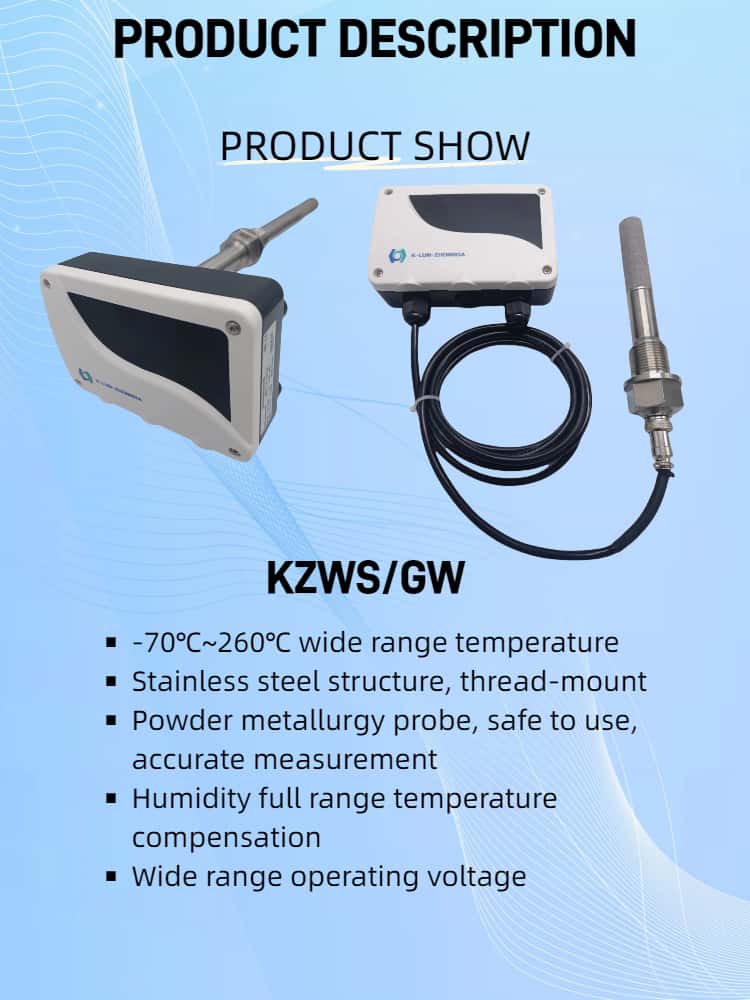
The Kunlun Zhongda high temperature and humidity transmitters are the key hardware foundation for transitioning wood drying kilns from experience-based drying to precision drying. The high temperature adaptability, anti-condensation design, and industrial grade stability directly determine the intelligence level of the drying process and the quality of the final product.
Application of Kunlun Zhongda High Temperature and Humidity Transmitter in Wood Drying Kilns

The deep value of screw pump temperature sensors lies not in single point measurement but in a four-in-one system including transient protection, stator smart algorithm, triangular fusion diagnostics and SIL functional safety, which enable most component suppliers to upgrade to system solution providers.
Applications of Temperature Sensors in Screw Pumps

From passive alarm to proactive prediction, from single-point measurement to multi-parameter fusion, that is the technical foundation for the shift from "scheduled maintenance" to "predictive maintenance" by using temperature sensors in multistage high pressure pumps.
Application of Temperature Sensors in Multistage High Pressure Pumps

The value of temperature sensor monitoring lies not in "knowing the current temperature" but in "predicting what it will become",from passive alarm to proactive prediction, this is the technical foundation of the shift from scheduled to predictive maintenance.
Application of Temperature Sensors in Centrifugal Pumps