
From "Replacement" to "Surpassing": The 20-Year Overtaking Journey of a Chinese Sensor Enterprise
author: jennie
2026-01-29
I. The Pain of Import Dependency: When Standard Products Meet Non-Standard Working Conditions
In 2025, China's industrial sector was undergoing a quiet yet profound transformation. In the control room of a medium-sized chemical plant in Hebei, technicians carefully removed a Swiss-branded temperature sensor and replaced it with a silver domestic probe bearing the words "Kunlun Zhongda." This seemingly ordinary equipment replacement marked a critical turning point in China's industrial sensor field—localized customization technology began systematically replacing imported standard products.
"Initially, we just didn't want to be 'strangled' by foreign suppliers anymore," recalled the chemical plant's equipment department manager. At the time, the imported sensors used on the production line were not only expensive, with lead times as long as six months, but their technical parameters were also rigid, unable to adapt to the special working conditions after the production line upgrades. "The most challenging issues were the humid environment and chemical corrosion. Standard products required replacement every three months on average, and the production losses from downtime far exceeded the value of the sensors themselves."
II. On-Site Diagnosis by a Chinese Sensor Manufacturer: The Problem Is Not Accuracy, but Adaptability
The turning point came during an industry exchange conference. Through a peer recommendation, the company found Kunlun Zhongda, which had already accumulated over a decade of technical expertise as a Chinese Sensor Manufacturer. Unlike typical suppliers, Kunlun Zhongda's engineers did not immediately quote a price. Instead, they spent three days at the factory with testing equipment, recording complete temperature curves from the high-temperature zones of the reactors to the cooling pipelines, and even analyzing the specific chemical composition of the workshop air.
"We discovered that the fundamental problem wasn't insufficient sensor accuracy, but rather that the packaging materials and temperature measurement algorithms were unsuitable for such 'non-standard' environments," explained the senior engineer who served as the project lead. Standard sensors used general stainless steel housings, which were prone to pitting corrosion in humid air containing chloride ions. Meanwhile, the temperature measurement algorithms of international brands were designed for ideal laboratory conditions, causing lag in response to the abrupt temperature changes characteristic of chemical workshops.
III. The Birth of Chemical Industry Sensor Solutions: From "Reverse Customization" to Technological Breakthrough
The real breakthrough came from a 'reverse customization' experiment. Kunlun Zhongda did not replicate the technical approach of the imported products. Instead, based on their self-developed dual-bridge arm compensation technology, they redesigned the sensor's physical structure and signal processing logic: adopting special alloy housings with multi-layer passivation treatment, developing adaptive filtering algorithms to eliminate electromagnetic interference, and even adding corrosion-resistant braiding to the connection cables—this complete set of Chemical Industry Sensor Solutions was tailor-made for the chemical sector.
However, the path of innovation is never smooth. The first three sample sensors delivered, while performing excellently in laboratory tests, exhibited issues like signal drift and seal failure—symptoms of "acclimatization"—in the field. "With each failure, the client analyzed the causes alongside us," project records show. The sealing structure alone underwent seven iterations, evolving from traditional O-ring seals to a composite solution combining metal welding and special rubber.
IV. The Value Validation of Sensor Customization Services: From Replacement to Surpassing
In the spring of 2013, the fourth-generation customized sensor operated continuously and stably for over six months after installation, with performance metrics comprehensively surpassing the original imported product, while priced at only one-third of the latter's cost. More crucially, Kunlun Zhongda established a rapid response mechanism for this—from fault reporting to an engineer arriving on-site with spare parts, the fastest response time was just 4 hours, compared to more than two weeks for the previous foreign supplier.
This successful "replacement campaign" created a ripple effect. Over the following year, the chemical plant progressively replaced the temperature monitoring systems across three production lines with Kunlun Zhongda's customized solutions, reducing comprehensive operation and maintenance costs by 47% and unplanned downtime by 82%. "What we purchased wasn't just sensors, but a partnership for continuous technological optimization," emphasized the company's technical director in a subsequent interview.
Kunlun Zhongda's Sensor Customization Services are not limited to a single client. This deep customization capability was later systematically applied to multiple national key projects. In the heating security system for the 2008 Beijing Olympics, sensors needed to maintain long-term stability of ±0.1°C under extreme winter lows. In the remote control systems of North China Oilfield, sensors had to achieve wireless data transmission in the depths of grasslands at -40°C. In the water supply systems of provincial television stations, they needed to maintain measurement accuracy under high-frequency water hammer impacts. Every challenge tested and elevated the technical ceiling of this Chinese Sensor Manufacturer.
V. A Twenty-Year Lesson: The Battlefield for Industrial Sensors Is on the Production Site
"The battlefield for industrial sensors isn't in the laboratory, but on the client's production site," summarized Kunlun Zhongda's technical director when reflecting on the company's development. It was this "on-site-centric" R&D philosophy that allowed this Chinese Sensor Manufacturer to evolve from initially replacing imported products as a "follower," to gradually becoming a "frontrunner" capable of providing solutions that surpass international standards in specific scenarios.
As a professional Chinese Sensor Manufacturer, Kunlun Zhongda provides Chemical Industry Sensor Solutions covering chemicals, petroleum, power, metallurgy, and other industries, as well as flexible Sensor Customization Services to help customers solve the pain point of "standard products unable to adapt to special working conditions."
Today, as "Made in China" transforms into "Intelligent Manufacturing in China," Kunlun Zhongda's case reveals a deeper industrial law: Breakthroughs in high-end manufacturing often occur not in general technology domains, but are nurtured within 'non-standard' application scenarios overlooked by international giants. The unique production environment of each industry can become a distinctive testing ground for Chinese enterprises to achieve technological overtaking.
Starting with replacing a single imported sensor to redefining technical standards in niche industries, this company's two-decade journey is a microcosm of independent innovation in China's industrial components sector—not chasing on tracks set by others, but carving out its own upward path by solving the practical problems in Chinese factories.
View more from YouTube.
From "Vague Requirements" to "Precise Matching": How a Sensor Sale Evolved into a New Paradigm of Technical Cooperation
Customizing Temperature for Clients for 20 Years: How Kunlun Zhongda Captured a Farm with a Single Sensor
Related Article

Results indicate that fluoride ion electrode in the system offers fast response and high accuracy, effectively reducing chemical costs and enhancing process automation to ensure compliant industrial wastewater discharge.
Application of Fluoride Ion Electrodes in Semiconductor Industry Wastewater Treatment
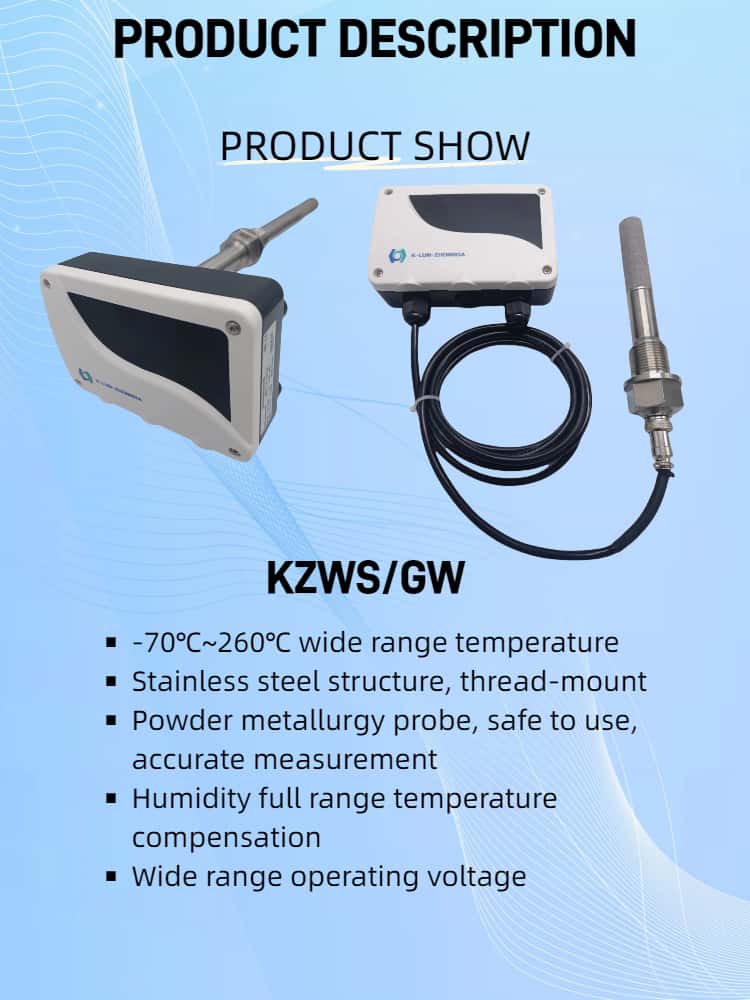
The Kunlun Zhongda high temperature and humidity transmitters are the key hardware foundation for transitioning wood drying kilns from experience-based drying to precision drying. The high temperature adaptability, anti-condensation design, and industrial grade stability directly determine the intelligence level of the drying process and the quality of the final product.
Application of Kunlun Zhongda High Temperature and Humidity Transmitter in Wood Drying Kilns

The deep value of screw pump temperature sensors lies not in single point measurement but in a four-in-one system including transient protection, stator smart algorithm, triangular fusion diagnostics and SIL functional safety, which enable most component suppliers to upgrade to system solution providers.
Applications of Temperature Sensors in Screw Pumps

From passive alarm to proactive prediction, from single-point measurement to multi-parameter fusion, that is the technical foundation for the shift from "scheduled maintenance" to "predictive maintenance" by using temperature sensors in multistage high pressure pumps.
Application of Temperature Sensors in Multistage High Pressure Pumps