
Carbon Nanotube Sensors Break Through Bottlenecks: Revolutionizing Environmental Safety Monitoring from Single-Molecule Detection to Networked Surveillance
author: jennie
2026-01-14
Traditional carbon nanotube sensors, while capable of detecting hazardous substances such as nitro oxides and nerve agents through changes in fluorescence intensity, have long been plagued by issues such as interference from ambient light, high error rates, and significant signal noise. Now, the Stanow Laboratory has achieved a dual breakthrough with fluorescence wavelength analysis technology and peptide-nanotube composite coating technology, redefining the precision and scope of chemical sensing.
I. Technological Leap: From "Fluorescence Intensity" to "Wavelength Fingerprinting"
Traditional sensors rely on changes in fluorescence intensity, which are easily disrupted by fluctuations in external light. The new generation of sensors shifts to monitoring the shift in fluorescence wavelength when carbon nanotubes bind with target molecules, paired with a custom-designed microscope to capture nanoscale signal changes invisible to the naked eye. This transformation allows the sensors to maintain stable recognition capabilities even in complex environments, enabling the detection of trace compounds at the single-molecule level.
In the field of environmental monitoring, this technological breakthrough in Carbon nanotube sensors provides a new technical pathway for Agricultural pollutant monitoring and Drinking water safety detection. Traditional agricultural pollutant detection often requires complex sample pretreatment and laboratory analysis, while wavelength fingerprinting-based Carbon nanotube sensors are expected to enable rapid on-site screening, significantly improving detection efficiency.
II. Peptide Coating Technology: Building an "Explosive Olfaction Network"
The research team designed different peptide sequences (bombolitins) as coatings, enabling carbon nanotubes to distinguish between various nitro-aromatic compounds. Each nanotube–peptide combination acts as a chemical fingerprint recognition unit, capable of not only identifying original explosives like TNT but also capturing their environmental degradation byproducts, enabling comprehensive monitoring of entire "reaction chains."
This technological breakthrough offers new possibilities for Agricultural pollutant monitoring—the complex mixtures of pesticides and their degradation products have long been a challenge in agricultural environmental monitoring.
Carbon nanotube sensors combined with peptide coating technology can simultaneously identify multiple target substances and their metabolites, providing technical support for precise source tracing of agricultural non-point source pollution. Similarly, in the field of Drinking water safety detection, this technology is expected to enable simultaneous monitoring of trace organic pollutants and their disinfection byproducts in water sources, enhancing early warning capabilities for drinking water safety.
III. Challenges and Prospects: From Laboratory to Real-World Applications
Although this technology has not yet been deployed in public safety scenarios such as subways, its breakthrough significance is already evident:
-
Ultra-High Sensitivity: Detection signals can be triggered by a single molecule
-
Environmental Adaptability: Capable of tracking the degradation pathways of target substances under natural conditions
-
Platform Potential: Provides foundational technical support for building multidimensional hazardous substance monitoring networks
Stanow Laboratory notes, "What we need is no longer a tool to detect a single substance, but an intelligent sensing system capable of dynamically capturing chemical change networks."
From the core breakthrough of Carbon nanotube sensors to the application extensions in Agricultural pollutant monitoring and Drinking water safety detection, this technology is moving from the laboratory to broader environmental monitoring scenarios.
IV. Local Practices in Industrial Sensing: Kunlun Zhongda's Philosophy of Reliability
While international research focuses on breakthroughs in nanoscale sensing, China's industrial sensor sector is achieving reliability upgrades through long-term technological refinement. For example, Beijing Kunlun Zhongda has dedicated two decades to advancing temperature, humidity, and pressure sensing technologies, providing high-stability solutions for scenarios such as Olympic venues, rail transit, and industrial manufacturing. This reflects the complete chain from laboratory innovation to engineering application.
Kunlun Zhongda understands that whether it is the breakthroughs of Carbon nanotube sensors in environmental monitoring or the practical needs of Agricultural pollutant monitoring and Drinking water safety detection, ultimately, stable and reliable sensor products are needed to carry the technology to real-world implementation. This is the philosophy Kunlun Zhongda has upheld for two decades—transforming cutting-edge technologies into products that can withstand on-site challenges.
V. Insight: Symbiosis Between Microscopic Breakthroughs and Macroscopic Applications
The evolution of carbon nanotube sensors reveals a technological development path:
-
Fundamental Research Breakthroughs (fluorescence wavelength analysis)
-
Cross-Technology Integration (peptide biological coatings + nanomaterials)
-
Scenario-Specific Adaptation (ability to track environmental degradation products)
Meanwhile, the industrial sector transforms cutting-edge technologies into reliable productivity tools through engineering validation and scalable applications. Together, they advance sensing technology from "passive detection" to "active warning."
In the future, as Carbon nanotube sensors continue to improve in selectivity and anti-interference capabilities, they are expected to integrate with IoT and artificial intelligence systems, building intelligent protection networks from chemical molecules to urban safety. In this process, the acuity of scientific breakthroughs and the stability of industrial practices will serve as dual engines driving the sensor revolution.
Conclusion: From Molecular Detection to Environmental Safety—Let Sensing Technology Protect Every Drop of Water and Every Inch of Soil
From the single-molecule detection breakthroughs of Carbon nanotube sensors, to the precise source tracing of Agricultural pollutant monitoring, to the real-time early warning of Drinking water safety detection, every advancement in sensing technology is redefining our ability to safeguard environmental safety.
Does your project also require sensing solutions for environmental safety monitoring?
Whether it is online monitoring of agricultural non-point source pollution or risk early warning for drinking water safety, Kunlun Zhongda's technical team is willing to work with you to provide reliable and precise sensing technology support.
👉 Inquire Now: Get your customized environmental monitoring sensing solution
📞 Technical Hotline: 13220160485
📧 Send Your Requirements: wangweisu@klsensor.com
📞 Technical Hotline: 13220160485
📧 Send Your Requirements: wangweisu@klsensor.com
Let every detection become a solid defense line for environmental safety.
View more from YouTube.
Technology Breakthroughs Win Trust: Kunlun Zhongda Armored Thermocouples Contribute to Nuclear Power Safety, Gaining Long-Term Recognition from National-Level Research Institutes
The Science of Humidity Measurement: Kunlun Zhongda Decodes Multi-Principle Technologies Empowering Modern Industry
Related Article
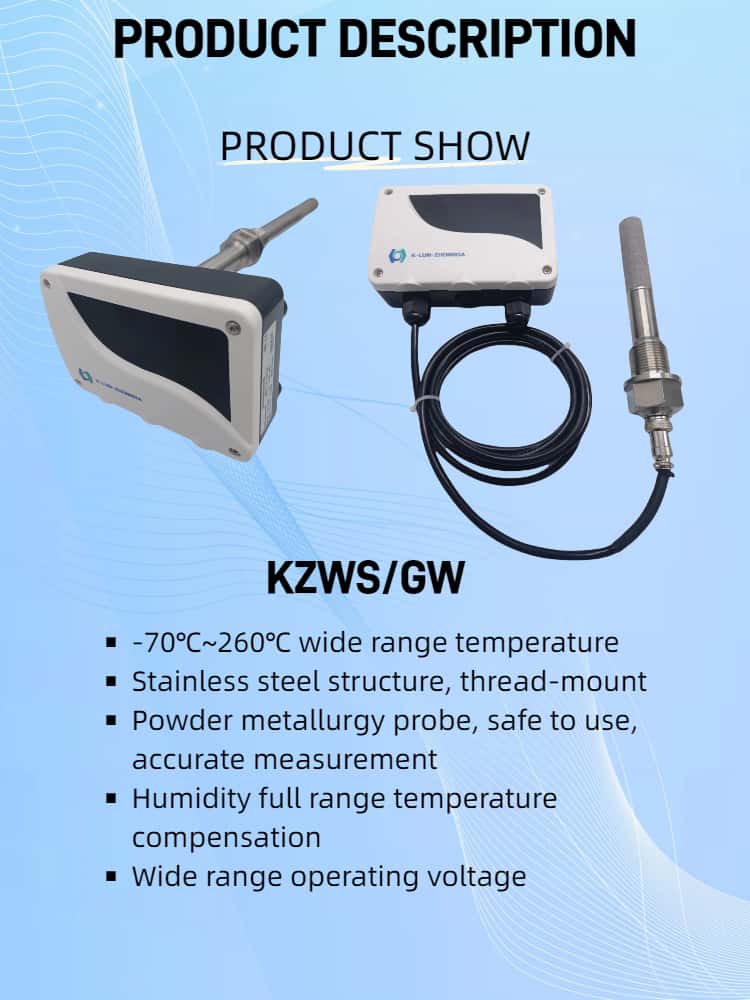
The Kunlun Zhongda high temperature and humidity transmitters are the key hardware foundation for transitioning wood drying kilns from experience-based drying to precision drying. The high temperature adaptability, anti-condensation design, and industrial grade stability directly determine the intelligence level of the drying process and the quality of the final product.
Application of Kunlun Zhongda High Temperature and Humidity Transmitter in Wood Drying Kilns

The deep value of screw pump temperature sensors lies not in single point measurement but in a four-in-one system including transient protection, stator smart algorithm, triangular fusion diagnostics and SIL functional safety, which enable most component suppliers to upgrade to system solution providers.
Applications of Temperature Sensors in Screw Pumps

From passive alarm to proactive prediction, from single-point measurement to multi-parameter fusion, that is the technical foundation for the shift from "scheduled maintenance" to "predictive maintenance" by using temperature sensors in multistage high pressure pumps.
Application of Temperature Sensors in Multistage High Pressure Pumps

The value of temperature sensor monitoring lies not in "knowing the current temperature" but in "predicting what it will become",from passive alarm to proactive prediction, this is the technical foundation of the shift from scheduled to predictive maintenance.
Application of Temperature Sensors in Centrifugal Pumps