
How to Precisely Control the Drying End Point of Agricultural Waste? Xi'an Customer Chooses High-Temperature Sensors for Real-Time Monitoring
author: jennie
2025-12-04

[Beijing, Recent] In the field of agricultural resource utilization, how can waste materials like wheat straw and rice husks be transformed into stable, usable resources? One of the key technical steps—the drying process—requires precise monitoring to ensure an optimal balance between energy efficiency and product quality. Recently, an enterprise in Xi'an specializing in biomass energy utilization turned to Beijing Kunlun Zhongda Sensor Technology Co., Ltd., seeking high-temperature humidity sensor solutions for its wheat straw drying pipeline system. This collaboration not only addressed a specific process challenge but also highlighted the crucial role of specialized sensors in enhancing the intelligence and reliability of entire systems in specific industrial scenarios.
Dual Challenges of High Temperature and Airflow: Why Are Generic Sensors "Inadequate"?
"We need to monitor the drying degree of wheat straw in real-time within the pipeline, with temperatures around 200℃," the Xi'an client's inquiry directly pinpointed the issue. Inside enclosed conveying pipelines, the high-temperature and dust-laden airflow environment poses severe challenges to sensors. Ordinary humidity sensors often fail due to their inability to withstand prolonged high temperatures or their rapid degradation in accuracy under high-speed airflow, mechanical vibrations, and media erosion. The client's description—"wheat straw is conveyed through pressure within the pipeline"—clearly outlines a dynamic and harsh measurement environment.
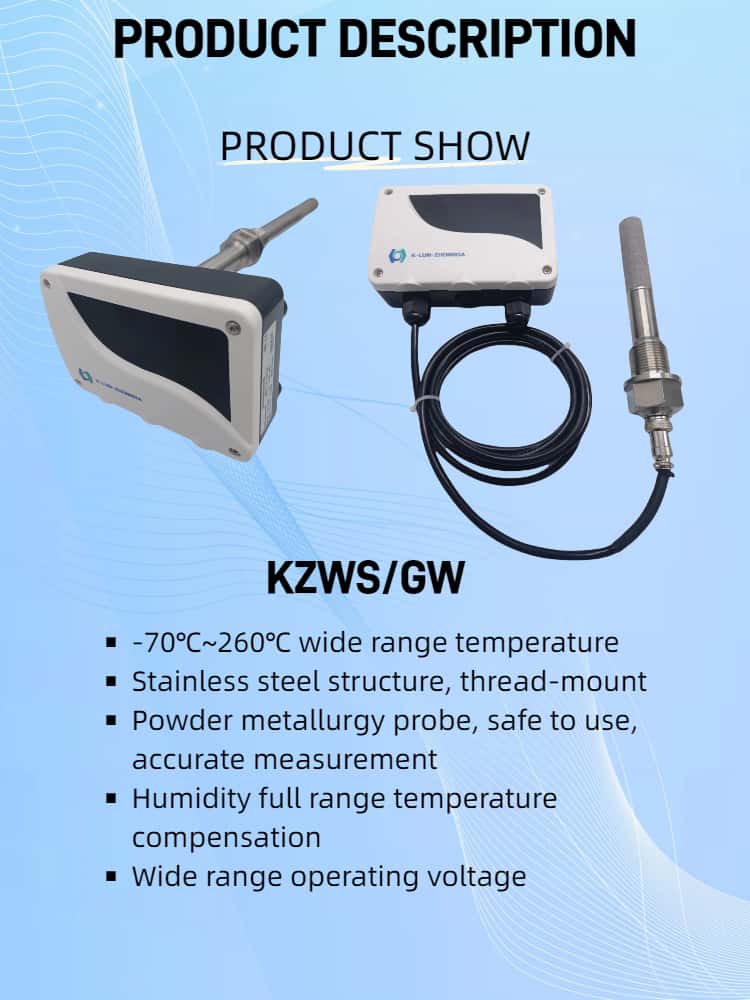
"This is precisely where our high-temperature humidity sensors excel," explained a Kunlun Zhongda technical engineer. The client required not only high-temperature resistance but also long-term stability and accuracy under conditions of high temperature, pressurized airflow, and potential particulate interference. To address such pipeline applications, Kunlun Zhongda implements additional structural reinforcement and protective treatments during the production process. These include using more erosion-resistant probe materials, optimizing the layout of sensing elements to withstand airflow impact angles, and enhancing mechanical fixation and sealing. These measures ensure the sensor remains reliable in such dynamic environments, even within a wide measurement range of up to 300℃.
From Inquiry to Order: How Did the Professional Solution Win Swift Trust?
Faced with this specific requirement, Kunlun Zhongda did not simply offer a standard product model. Instead, drawing on extensive application experience, the company engaged in in-depth technical discussions with the client for over a week. The discussions covered details such as the specific temperature distribution within the pipeline, airflow velocity, the approximate moisture content range of the wheat straw, and the desired control accuracy. This focus on solving the specific problem rather than merely selling a product quickly established professional trust.
"Although there are few manufacturers in the industry capable of providing such high-temperature, high-stability humidity sensors, and our pricing is more competitive than imported products, the client ultimately chose us because we could clearly explain how our product adapts to their specific working conditions and provided successful application cases from similarly harsh environments in the past," stated a Kunlun Zhongda sales director. The repeat purchase records of many long-term clients served as the most compelling endorsement of quality. Ultimately, after a comprehensive evaluation, the Xi'an client promptly placed a purchase order.
Beyond Individual Products: How Do Specialized Sensors Empower Traditional Industry Upgrades?
This collaboration offers a case study on the role of sensor technology in upgrading traditional industries. In fields such as agricultural waste resource utilization and biomass fuel production, precise control of the drying process directly affects product quality, energy consumption levels, and production costs. What Kunlun Zhongda provided was not merely a sensor capable of withstanding 300℃ but a sensing solution enabling "real-time control of the drying degree." This signifies the evolution of production processes in related fields from relying on empirical judgment to precise control based on real-time data.
About Kunlun Zhongda
Beijing Kunlun Zhongda Sensor Technology Co., Ltd. is a technology-driven enterprise focused on high-tech and cutting-edge innovations. The company specializes in the research, development, and manufacturing of products such as high-temperature humidity sensors, contact thermocouple temperature detectors, and enclosed digital temperature sensors. Kunlun Zhongda is committed to providing reliable, specialized sensing products to offer precise measurement and control support for clients in industrial automation, agricultural modernization, energy conservation, and environmental protection. The company aims to contribute to the intelligent upgrading of industries through its advanced sensing solutions.
View more from YouTube.
How Can the Textile Industry Achieve Breakthroughs in Temperature and Humidity Control? Why Did a Zhejiang Client Quickly Choose Kunlun Zhongda After Inquiring About High-Temperature Sensors?
How Are Domestic Sensors Winning Over Long-Term Users of Imported Brands? The Transformation Choice of a Shanghai Client Provides the Answer
Related Article
The Kunlun Zhongda high temperature and humidity transmitters are the key hardware foundation for transitioning wood drying kilns from experience-based drying to precision drying. The high temperature adaptability, anti-condensation design, and industrial grade stability directly determine the intelligence level of the drying process and the quality of the final product.
Application of Kunlun Zhongda High Temperature and Humidity Transmitter in Wood Drying Kilns

The deep value of screw pump temperature sensors lies not in single point measurement but in a four-in-one system including transient protection, stator smart algorithm, triangular fusion diagnostics and SIL functional safety, which enable most component suppliers to upgrade to system solution providers.
Applications of Temperature Sensors in Screw Pumps

From passive alarm to proactive prediction, from single-point measurement to multi-parameter fusion, that is the technical foundation for the shift from "scheduled maintenance" to "predictive maintenance" by using temperature sensors in multistage high pressure pumps.
Application of Temperature Sensors in Multistage High Pressure Pumps

The value of temperature sensor monitoring lies not in "knowing the current temperature" but in "predicting what it will become",from passive alarm to proactive prediction, this is the technical foundation of the shift from scheduled to predictive maintenance.
Application of Temperature Sensors in Centrifugal Pumps