
Why Semiconductor Manufacturing Has the Strictest Requirements for Temperature Sensors
author: KLZD
2026-08-09

The core reason of semiconductor manufacturing requires the strictest temperature sensors is The Physics Has No Margin.
At sub-5nm process nodes, a small 2°C temperature deviation on a wafer surface will be possible to cause millions of transistors to breakdown. Any other industry has nothing on operation at this kind of level of thermal sensitivity. The laws of physics at the nanoscale leave almost no fault tolerance. The semiconductor requires temperature sensors to measure.
Process Node Is Keeping Shrinking, The Tolerance Is Keeping Tightening.
The chips are getting smaller, every parameter will be tightened, so the temperature sensors are very important to measure.
28nm node — temperature tolerance ±5°C, relatively flexible
7nm node — temperature tolerance shrinks to ±2°C, any fluctuation will impact the device parameters
3nm node — temperature tolerance under ±1°C, the temperature sensors accuracy will become the pass rate and yield ceiling
7nm node — temperature tolerance shrinks to ±2°C, any fluctuation will impact the device parameters
3nm node — temperature tolerance under ±1°C, the temperature sensors accuracy will become the pass rate and yield ceiling
The physics logics behind it is very simple, the active regions (like transistor gates, dopant zones, dielectric layers) are measured in atomic layers at smaller nodes. A small temperature shift will change atomic-level reaction rates, layer thicknesses, and dopant distributions in ways that cannot be corrected in downstream process.
Six Critical Processes Requirements Are Almost Impossible.
Rapid Thermal Processing (RTP / RTA)
Heating rates reach 100–300°C per second. Temperature Sensors should respond in microseconds. Conventional industrial temperature sensors with millisecond response are useless — the process is already done by the time they react.
Atomic Layer Deposition (ALD)
Temperature should be controlled to ±0.3°C. The ±1°C fluctuation will cause over 1% film thickness variation. For a 3nm gate oxide layer (about 5 atomic layers), 1% thickness means roughly 0.05 atomic layers out of control. The accuracy of temperature sensors become more important.
Temperature should be controlled to ±0.3°C. The ±1°C fluctuation will cause over 1% film thickness variation. For a 3nm gate oxide layer (about 5 atomic layers), 1% thickness means roughly 0.05 atomic layers out of control. The accuracy of temperature sensors become more important.
Post-Exposure Bake (PEB) in Lithography
Photoresist chemistry is extremely sensitive to bake temperature. The ±1°C deviation will cause over 2% change of Critical Dimension (CD). At advanced nodes, CD tolerances are already at their physical limits — a 2% shift means the batch will be all scrapped. The temperature sensors may measure accurately to avoid it.
Photoresist chemistry is extremely sensitive to bake temperature. The ±1°C deviation will cause over 2% change of Critical Dimension (CD). At advanced nodes, CD tolerances are already at their physical limits — a 2% shift means the batch will be all scrapped. The temperature sensors may measure accurately to avoid it.
CVD / PVD Thin Film Deposition
Spans temperatures from under 100°C to over 1000°C depending on the different film materials. Metal gate and high-k dielectric deposition require uniformity within ±0.5°C across the entire wafer surface.
Spans temperatures from under 100°C to over 1000°C depending on the different film materials. Metal gate and high-k dielectric deposition require uniformity within ±0.5°C across the entire wafer surface.
Plasma Etching
It will combine ultra-high vacuum, plasma bombardment, and intense 13.56 MHz RF electromagnetic fields simultaneously. Most temperature sensors would fail from RF noise alone before even not measuring temperature.
It will combine ultra-high vacuum, plasma bombardment, and intense 13.56 MHz RF electromagnetic fields simultaneously. Most temperature sensors would fail from RF noise alone before even not measuring temperature.
Post-Implant Anneal and Wafer Bonding
Millisecond anneal processes (melt anneal) require thermal capture in sub-millisecond. Temperature uniformity across the bonding interface determines the device reliability for coming years.
Millisecond anneal processes (melt anneal) require thermal capture in sub-millisecond. Temperature uniformity across the bonding interface determines the device reliability for coming years.
The Effective Solution on above challenges will be suggested to adopt TC Wafer and RTD Wafer. To embed the temperature sensors directly into the wafer itself will eliminate the thermowell entirely.
TC Wafer — embeds thermocouple arrays (up to 68 points) directly on the wafer surface
Temperature range: −200°C to 1,200°C
Accuracy: ±0.1°C after calibration
Response: microsecond-level
Vacuum: compatible to 10⁻⁷ Torr
Temperature range: −200°C to 1,200°C
Accuracy: ±0.1°C after calibration
Response: microsecond-level
Vacuum: compatible to 10⁻⁷ Torr
RTD Wafer — platinum resistance sensors for mid-to-low temperature, ultra-high precision
Temperature range: −80°C to 250°C
Accuracy: ±0.05°C (precision grade)
Use case: coat/developing hotplates, etch electrostatic chucks
Temperature range: −80°C to 250°C
Accuracy: ±0.05°C (precision grade)
Use case: coat/developing hotplates, etch electrostatic chucks
The advantaged solutions will pushing forward the semiconductor manufacturing at the absolute frontier of temperature sensors technology.
Oil Sensors and Intelligent Manufacturing
KLZD Oil Sensors Empower Industrial Equipment Predictive Maintenance
Related Article
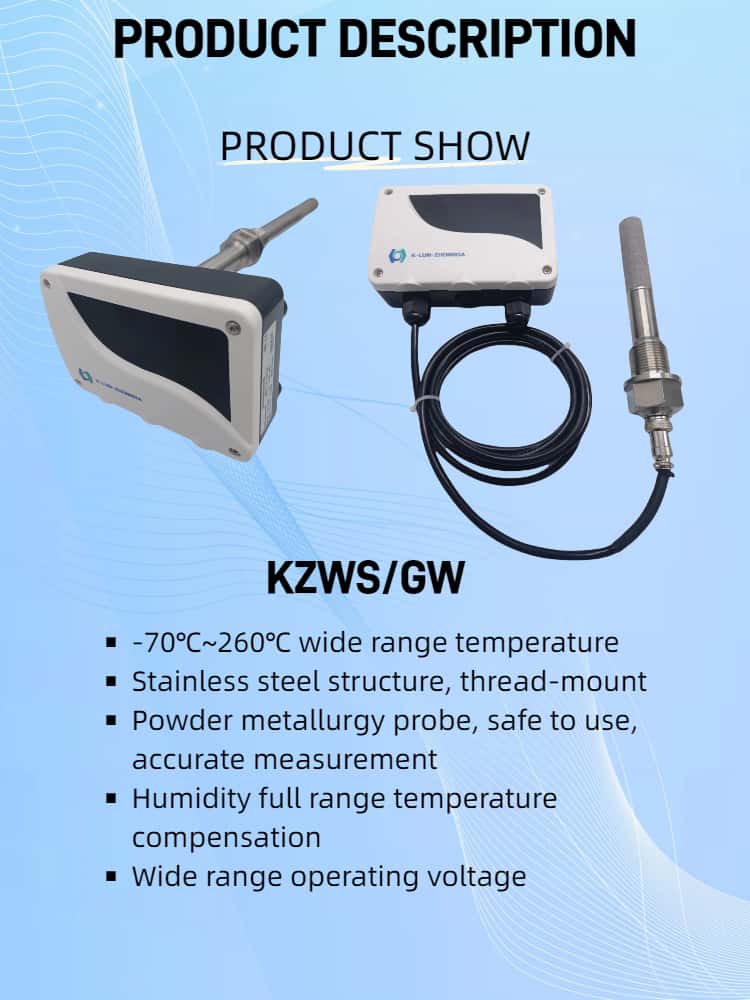
The Kunlun Zhongda high temperature and humidity transmitters are the key hardware foundation for transitioning wood drying kilns from experience-based drying to precision drying. The high temperature adaptability, anti-condensation design, and industrial grade stability directly determine the intelligence level of the drying process and the quality of the final product.
Application of Kunlun Zhongda High Temperature and Humidity Transmitter in Wood Drying Kilns

The deep value of screw pump temperature sensors lies not in single point measurement but in a four-in-one system including transient protection, stator smart algorithm, triangular fusion diagnostics and SIL functional safety, which enable most component suppliers to upgrade to system solution providers.
Applications of Temperature Sensors in Screw Pumps

From passive alarm to proactive prediction, from single-point measurement to multi-parameter fusion, that is the technical foundation for the shift from "scheduled maintenance" to "predictive maintenance" by using temperature sensors in multistage high pressure pumps.
Application of Temperature Sensors in Multistage High Pressure Pumps

The value of temperature sensor monitoring lies not in "knowing the current temperature" but in "predicting what it will become",from passive alarm to proactive prediction, this is the technical foundation of the shift from scheduled to predictive maintenance.
Application of Temperature Sensors in Centrifugal Pumps